Sunday, December 04, 2005

Excessive Executive Pay

Topic: Management Improvement

Via Christian Sarkar, Too Many Turkeys, The Economist:

Executive compensation in America - —already far ahead of the rest of the world, despite the best efforts of overseas managers to catch up - —is now rising inexorably again. In fiscal year 2004 the total compensation of the median American company boss rose in every industry... according to a new report by the Conference Board, a research organisation. In the big companies that comprise the S&P 500 index, median total chief-executive compensation increased by 30.2% last year, to $6m, compared with a 15% rise in 2003


Christian Sarkar asks, can we outsource the CEO to a low-cost country? That is exactly what will happen at the ludicrous levels pay has risen to. If the United States were to lock into a payscale that is unsustainable globally US companies will be no be able to compete. My guess is plenty of people in the USA will be glad to compete against the brooks brothers bureaucrats but if not, others will.

The excesses are so great now they will either force companies to:
  1. take huge risks to justify such pay and then go bankrupt when such risks fail (and some will succeed making it appear that they pay was deserved rather than just the random chance of taking a large risk and getting lucky).
  2. make it impossible to compete with companies that don't allow such excesses and slowly go out of business to those companies that don't act so irresponsibly
  3. hope that competitors adopt your bad practice of excessive pay (this does have potential as most people are corrupted by power, even across cultural boundaries). However, my expectation is the competitive forces of capitalism going forward are going to make such a hope unrealistic. People will see the opportunity provided by such poor management and compete with them.

As long as the pay packages were merely large, and didn't effect the ability of a company to prosper that could continue (slicing up the benefits between the stakeholders is not an exact science). The excesses recently have become so obscene as to become unsustainable.

Companies will not be able to compete if they allocate huge portions of the benefits provided by the operations of the company to the few sitting on top of the bureaucracy. On the other hand large pay for Directors alternatively is sustainable as it hardly impacts the overall results of the company directly. The poor performance of boards that may well be caused by directors feeling more obligated to the top bureaucrats for their large pay is a different matter.

Companies that provide huge benefits to those few at the expense of investors, the rest of the employees, customers, suppliers... will find the other stakeholders find it better to go elsewhere and interact with those companies that are more equitable.

Because those that are taking excess portions of the benefits of corporations have power to determine whether those companies stop providing excessive benefits to themselves I am sure many will slowly go out of business all the while blaming other factors. With the current system the most likely force to stop such abuse are those representing the investors.

Those taking excessive gains for themselves have learned how to block the interests of the owners fairly effectively, turning boards into pawns of the top bureaucrats instead of the owners. Those bureaucrats have advantages in the battle to allocate the gains fairly but I believe they are overplaying that advantage and over time the tide will change. But time will tell what actually happens.

Related posts:

Tuesday, November 29, 2005

Firefox 1.5 and Rollyo

Topic: Internet

The new Firefox 1.5 web browser is available. It is a great browser I have been using for at least a year. It is free, secure and has great features.

You can also try a search "roll" I have setup for the various curiouscat.com sites (via Rollyo). This allows you to search those sites I have included in the "roll" and only those sites.

I have also setup a management "roll" which includes some of my favorite management sites. This is a great tool that lets you search a predefined list of sites (including blogs). You can also setup your own "rolls." I think this is a very nice feature, let me know what you think.

You can add these search rolls to your Firefox search box (so you can select to search using Google, Yahoo... or one of these search rolls).

Also, if you have not looked at Open Office yet, take a look at it also (previous post: OpenOffice 2.0). We also have a page with some of the freeware we think is worthwhile.

Monday, November 28, 2005

Toyota Chairman Comments on India and Thailand

Topic: Management Improvement

Toyota Chief Comments on India, Thai Cos.

The chairman of Toyota Motor Corp. said Monday that auto companies in India and Thailand may soon overtake those in Japan because of their increasing focus on quality.


While this might be a bit of an exaggeration part of what keeps Toyota improving is that they do not rest on their past success. They are continually looking to improve.

He said no Japanese firm has won the Deming prize in recent years as they are not showing interest in winning this coveted prize, whereas Indian companies such as motorcycle and scooter maker, TVS Motor Co. and Rane TRW Steering Systems Ltd. have won the Deming prize.


More news on Okuda Hiroshi's visit to India, Japan sees India shining

Toyota Motor Corporation chairman Okuda Hiroshi, who heads Japanese trade body Nippon Keidanren, will lead a high-powered mission to India from November 27-30.

The delegation is likely to meet Prime Minister Manmohan Singh, finance minister P Chidambaram and commerce minister Kamal Nath.


Related Posts:

Sunday, November 27, 2005

Management Improvement

Topic: Management Improvement

Lean Manufacturing Visionary Jim Womack On Frontiers Of Lean Thinking, webcast and additional questions and answers:

Question: For a firm seeking to improve -- what comes first? Six Sigma quality or lean implementation?

James Womack: Agh! These are all the same thing. You need to start with the value stream for very product, draw a map of its current state, and ask about each step: Is it valuable? Is it capable? Is it available? Is it adequate? Is it flexible? Then ask whether each step flows smoothly to the next but only at the pull of the customer as the process approaches perfection. Doing this simple exercise wraps together everything you need to know about TQM, TPM, TPS, Six Sigma, TOC, etc

I believe while they are similar to varying degree they are not the same thing. They may have similar goals - they are largely focused at improving performance of the organization (but even how they would measure success is different). And when implemented well each of these methods have value. However what is done in an organization focused on six sigma is different than one focused on lean thinking.

These efforts can all be compatible. And while I believe differences do exist between these concepts, I largely agree:

When I have a bit more time for a talk, I explain that "lean", "six sigma", and all the other programs focusing on process management are largely the same and are complimentary. It's only the packaging efforts of competing consultants that creates the perception of fundamentally different approaches.

Many of the tools are used between the different programs and many of the important concepts are similar. Some tools are much more common in one program, even if they are not limited to one program (such as Design of Experiments used heavily in six sigma). But design of experiments existed long before six sigma and was used by sensible people to improve for decades before six sigma.

The biggest difference I see in the programs is the overall aim. And that overall aim effects everything else. I happen to be a fan of Deming's ideas. Most of these programs take a great deal from Deming's ideas. I believe Lean is closest to Deming's ideas (which makes sense as Lean is essentially the Toyota Production System TPS). In 1991, Shoichiro Toyoda, Honorary Chairman and director of Toyota Motor Corporation stated:

"There is not a day I don't think about what Dr. Deming meant to us. Deming is the core of our management."

At Toyota, Ohno and then Shingo created TPS, which includes many new ideas that are truly unique to TPS and are not really a part of what Deming taught, though they are consistent with his ideas. The focus of TPS is different than Deming's though much closer to Deming's ideas that most any other company. I believe they evolved to something that is unique and valuable. This is exactly what I would expect as more companies adopt better management methods and then proceed to evolve those methods in their organizations.

I think in the current application of lean thinking many ignore some of the valuable ideas from Deming (which may well be related to, as Womack stated: "packaging efforts of competing consultants"). Toyota obviously put a high value on Deming's ideas and those that try to adopt lean without understanding his ideas, can improve, but I believe they will be less successful over the long term.

Management concepts should evolve and improve over time. We should build upon the good ideas of yesterday and build in new innovations as they are shown to be effective. It is difficult to do so when consultants try to make their "solutions" proprietary methodologies that are sold in that way.

Luckily working with the ideas of Deming, Ohno, Drucker, achieve, Shingo, Scholtes, Womack, Box, etc.. and building upon them is what is needed to be successful. I find that management thinkers focused on improving management rather than selling a proprietary solution have the best ideas that are needed to improve management. Eli Goldratt and Joel Barker have some valuable ideas but seem to be more proprietary about those ideas, to me, than most of the others.

I will admit I am biased against proprietary solutions. I especially find it annoying as many proprietary solutions offer nothing actually unique, they just take old management tools and then rename them or twist a bit and claim this is some great new thing. I also think many hide their ideas from public scrutiny claiming they are "proprietary." I understand some good ideas are lurking in this area, still, I would be very reluctant to adopt proprietary management tools.

The continued evolving of quality management in six sigma, lean thinking and the adoption of many of the concepts into traditional management is a good thing. The current state of management improvement offers more good ideas and more refined ideas then ever before. And I do see lean thinking, six sigma, deming, systems thinking, theory of constraints, etc. as part of management improvement. The more learning from those focused in different areas there is the better; rather than forming isolated camps for improving the practice of management.

Related Posts:

Friday, November 25, 2005

Google: Experiment Quickly and Often

Topic: Management Improvement

Google Thinks Small by Quentin Hardy, Forbes:

Brin and Page have created a corporate organism that tackles most big projects in small, tightly focused teams, setting them up in an instant and breaking them down weeks later without remorse. "Their view is that there is much greater progress if you have many small teams going out at once," Schmidt says. The mission overall: to collect "all the world's information" and make it accessible to everyone. "It's a cause."
...
Hundreds of projects go on at the same time. Most teams throw out new software in six weeks or less and look at how users respond hours later.


Google has advantages in making this work for them (it is easy to find reasons it won't work elsewhere). However, this is basically piloting changes on a small scale, analyzing the results and doing that quickly and often. That quick, frequent experimentation is something organizations should strive to achieve.

The clear visible mission is also helpful. When an organization has an organizing principle everyone can understand then action can be guided by individual aim toward that purpose. When the understanding is missing organizations often have to rely on top down instruction and having far too many issues passed up the hierarchy for a decision.

And getting a small group of people to make things work quickly is also great. Many organizations get bogged down with byzantine management structures that slow action to a crawl.

Thursday, November 24, 2005

2005 Baldrige Award

The 2005 Baldrige Award recipients are:

  • Sunny Fresh Foods, Inc., Monticello, Minn. (manufacturing)
    • Product rejections for SFF at all four plants have continuously declined. Reducing rework can provide significant productivity improvements: SFF's rework reduction percentage was measured at 15 percent from 2001 to 2002, 61 percent from 2002 to 2003, and 75 percent from 2003 to 2004.
  • DynMcDermott Petroleum Operations, New Orleans, La. (service)
    • The storage cost per barrel was $3.00 for Japanese Oil Reserves, $2.40 for U.S. industry storage, $1.60 for the European Oil Stockpile and $.20 for the Strategic Petroleum Reserve, managed by DynMcDermott.
  • Park Place Lexus, Plano, Texas (small business)
    • Park Place Lexus Grapevine location had a New Car Client Satisfaction Index (CSI) of 99.8 percent in 2004 making it the highest rated Lexus dealership in the nation
  • Richland College, Dallas, Texas (education)
    • RLC's systematic process for design and evaluation of learning-centered processes utilizes a combination of qualitative, quantitative, in-process formative and end-process summative measures to ensure process requirements are met and to manage processes during day-to-day operations. In addition, standardized process drivers, such as measurements for its many KPIs, and defined curricula for learning processes help ensure a repeatable system is used to meet requirements.
  • Jenks Public Schools, Jenks, Okla. (education)
    • Drop-out rates, a measure of student satisfaction for JPS students, have decreased steadily from 6.3 percent in 1999 to 1.2 percent at the close of the 2004 school year.
  • Bronson Methodist Hospital, Kalamazoo, Mich. (health care)
    • BMH shows strong performance improvement and results in Medicare Mortality Rate (mortality rates of people over 65 enrolled in Medicare programs), moving from 4.8 percent in 2002 to 3.5 percent for January-July 2005. This performance exceeds both the CareScience Expected Standard, and the CareScience Best Practice.
It is difficult to get a sense of whether the Baldrige winners are really doing great things, or not. It would seem to me if they truly were worthy of recognition for exceptional management the highlights provided (following the links above) should be more impressive.

Tuesday, November 22, 2005

Be Thankful for Lean Thinking

Topics: Management Improvement and Economics

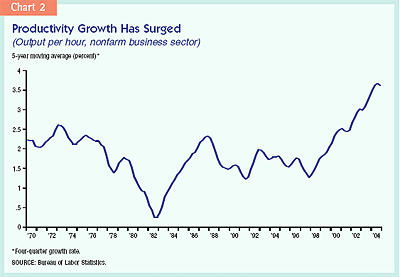
The Dallas Federal Reserve white paper, Supply Chain Management: The Science of Better, Faster, Cheaper by Thomas F. Siems provides a macroeconmic view of what to be thankful due to the practice of lean thinking:

Through better information engineering, supply chain improvements have resulted in a reduced bullwhip effect, lower inventory levels, reduced logistics costs, and streamlined payments. These improvements appear to have helped produce macroeconomic benefits such as more stable economic output and higher productivity growth.

Mass Production Era. In the early 1900s, Henry Ford created the first moving assembly line. This reduced the time required to build a Model T from 728 hours to 1.5 hours and ushered in the mass production era. Over the next 60 years, American manufacturers became adept at mass production and streamlined supply chains with the help of scientific management methods and operations research techniques.

Lean Manufacturing Era. But in the 1970s, U.S. manufacturing's superiority was challenged. Foreign firms in many industries made higher quality products at lower costs. Global competition forced U.S. manufacturers to concentrate on improving quality by reducing defects in their supply chains.

Starting in the early 1970s, Japanese manufacturers like Toyota changed the rules of production from mass to lean. Lean manufacturing focuses on flexibility and quality more than on efficiency and quantity. Significant lean manufacturing ideas include six-sigma quality control, just-in-time inventory and total quality management.


Ok, I don't think most experts would call six-sigma a lean manufacturing idea but this is a member of the dismal science singing macro-economic praises for the practice of lean thinking, so I think that point can be overlooked.

Sunday, November 20, 2005

Innovation and Research and Development

Topic: Economics and Management Improvement

Innovation and R&D by John Hagel:

From a competitive viewpoint, what matters is the relative rate of productivity improvement. R&D spending and patent filings will matter little if they do not translate into faster productivity improvement -– in fact, they can be a significant distraction. Those who understand this will have a significant edge as competition intensifies in the global economy.


I would argue innovation can be related to productivity improvement or it can be completely unrelated. A company could innovate with an ideas like the remote control for televisions (or microlending or air bags). That innovation may not contribute in any way to manufacturing televisions more productively.

Other innovation may be related to improving the productivity alone and add no additional functionality to the customer. Many innovations will provide a combination of both benefits. Both innovation and productivity improvement are important.

Quoting Michael Schrage's article:
The simple fact is that R&D spending - whether in euros, dollars or as a percentage of sales - is an input, not a measure of efficiency, effectiveness or productivity. Ingenuity, invention and innovation are rarely functions of budgetary investment.


John Hagel then states:

I only wish that Michael had gone a bit further and spent more time attacking a related fallacy: equating patents with innovation.


I agree with the weakness of using research spending and patents to measure innovation. I do not believe they are worthless as measures, however. Are there better measures? Outcome measures? If so, what are they? From the post I might guess productivity improvement might be such a measure. While that might be a useful measure it is hardly a sufficient one. I agree people should understand the weaknesses with the measures but I still believe they are useful in understanding where things stand and how things are changing.

The Innovation/Productivity Quotient by John Hagel III and John Seely Brown:

The real winners in terms of IT investment to generate major productivity advances have been highly innovative at two levels: They redesigned key business processes to exploit IT capabilities, and they focused on implementing continuing innovations in these business processes.


Related posts: