Showing posts with label management. Show all posts

Sunday, January 18, 2026

Why Does Toyota Share What They Do With Others?

Comment on LinkedIn post (over the years I have lost trust LinkedIn will honor links into LinkedIn - at times they work often, over the years, they are blocked), so I am not linking to the source.


Why would Toyota allow competitors to see their plants?

"Deep down, they know that the Toyota Production System (TPS) techniques that visitors see on their tours--the kanban cards, andon cords, and quality circles--represent the surface of TPS but not its soul. Toyota isn't worried about giving away any important secrets on a plant tour."

I agree it is true that other companies are not going to copy Toyota's ideas so successfully they would put Toyota at risk.

I think more than that though those that made such decisions early on cared about making the world a better place. Some companies in the USA talk about that but very few care about it. So it is easy to think anyone saying they care about making the world a better place is just making a false claim, likely as a marketing ploy.

When Toyota started doing this the life experience of those making decisions for Toyota very clearly knew the benefits they/Toyota gained from learning from others. Those people and companies helped make Toyota more successful and helping Japan recover from the devastation of World War II. To those that experienced this, it is easy to understand putting helping others above the potential risk of losing some competitiveness by helping competitors.

I do agree those making the decisions of keep sharing what is going on in Toyota now see how little they have to fear based on decades of sharing and seeing how little others have learned and applied what they share - so they have very little to fear.

Toyota has a much bigger risk now of losing focus on what makes them special (respect for people, systems thinking, long term thinking, continual improvement...) than they do from others. By making visible many aspects of how they operate they create a system that reinforces that they continue.

Using a very simple example, it is a lot easier to keep your house clean if you have guests over frequently. If you are going to get lazy it is easier to do if you just don't let others see. If you are letting others see most of us will take care to clean better. 

This is just one tiny aspect but I think there is real benefit if you are an executive concerned about maintaining high standards that you open yourself to others. When people are thinking about just skimping on things some there is extra reason to not do so. Also constantly reinforcing your message by having it repeated to visitors over and over, it keeps those ideas top of mind. Obviously this idea is vastly oversimplifying things. But I do believe there are significant system thinking reasons that Toyota's sharing benefits them and helps keep the company focused (much less important than many other things they do but still a benefit).

Related: The Top 21 Executives at Toyota Getting a Raise to a Combined US$14.9 Million (2015) - Long Term Thinking with Respect for People - The Toyota Way – Two Pillars

Friday, November 10, 2023

The Value of a Management System Accommodating Remote Work

Working remotely creates a significantly different system than working all next to each other. There are big advantages to working right next to each other. There are also really bad office designs (which are very common) which detract from success of working next to each other (distractions etc. that cubical farms, "hoteling" create etc.).

There are challenges to managing a system of work with people not being right next to each other. There are also huge advantages of hiring people that are not within commuting distance of your location. In my opinion organizations that learn to manage a dispersed workforce effectively will have huge competitive advantages long term.

Of course we have decades of evidence of organizations electing to ignore better management practices so I imagine most organizations will be dragged kicking and screaming into the future (if they ever get there at all).

There is some sense in my opinion to focusing on working all next to each other as your organization's management style. But my guess is for all but the richest organizations (that can afford to overpay, pay premiums to those that are willing to commute, willing to tie themselves to one physical location, happen to be in the area...) there are large gains possible by learning and creating a manage system that works effectively with remote workers. When you can't just pay huge salareis to put up with the large shortcomings of your management system it is important to find other ways to compete in the marketplace.

Figuring out how to work effectively remotely provides huge potential advantages for many organizations.

Thursday, March 07, 2019

Take Risks to Learn and Improve, But Do So Wisely

My edited comments on: The Limits of Learning From Failure

Failure can be a great learning tool, especially if it is planned. Create an environment that supports and learns from failure, but also use the scientific method, coupled with experience, to understand and mitigate the risks.

I agree, I wrote about this on my blog: Accept Taking Risks, Don’t Blithely Accept Failure Though

The goal is to maximize innovation and improvement. To the extent we need to take risks and accept some failures to achieve this we should accept failure. But that doesn’t mean we don’t continually try to improve our management systems to reduce the costs of failure. Even while we take risks we want to do so intelligently.

It is true many organization are so fearful of being blamed for failure that sensible risks are avoided. We do need to create management systems that allow taking sensible risks but we need to learn while still limiting damage from failures. Do experiments on a small scale, iterate quickly and expand the scope as you learn.

Related posts: Learn by Seeking Knowledge, Not Just from Mistakes - Risks Should be Taken Wisely - What is the Explanation Going to be if This Attempt Fails?

Sunday, January 27, 2019

Shared Principles for Managing People Engaged in Diverse Tasks

This post expands on my response to Michael Sweeney's (Cloud Infrastructure Engineering for Salesforce) comments on Linked In:

This is a great blog to follow [Curious Cat Management Improvement Blog] if you aren’t aware of it. I agree with John, in general, but in this post I felt the missed one basic thing that I’ve seen in my own career- software is not physical and people who write great software and people who make great physical things MUST think (and therefore be managed) differently. The crossover between Agile and Lean thinking, to me, is the ability to identify non-value added activity (waste) in the Toyota sense, and empower small teams to make decisions and charge forward in the Agile sense. Getting a combination of software and hardware thinking together will be the key to winning the Cloud Wars and moving into the Fourth Industrial Revolution.

Thanks for your comments. I do agree that the system within which people are operating determines how they must be managed. There are definitely features of software development that are significantly different than manufacturing scalpels or basketballs or tables. As there is a difference between a surgical team in an operating room, road construction, mining, editing books, investment banking, manufacturing industrial robots, researching new drugs, manufacturing drugs, teaching in a university, maintaining plane engines, coaching an athletic team...

I see universal principles of management (respect for people, customer focus, continual improvement...) that cross all different human enterprises. How those principles should be manifest in a particular situations depend on the work being done, the management system that is in place, the individual people involved, the specific focus of the effort right now... The way those principles are manifest will look very different in all the varied types of organizations we create and the different work and processes used within those organizations.

John Hunter, presenting at a Deming management seminar in Hong Kong

It is interesting (on the software v not software divide) to note that 100 years ago what was manufactured didn't contain software elements. And the manufacturing process also didn't involve software. That isn't very often the case today. Think of all the manufactured things you use and a high percentage (measured by the cost of the manufactured goods) have software components (cars, phones, appliances, speakers...) and they are built with a great deal of software involved in the manufacturing process.

In addition, the sales process and other processes involved in the organization doing the manufacturing rely heavily on software. As you say "Getting a combination of software and hardware thinking together" is indeed key today and will be continue to be in the future. While relying on software as part of the manufacturing process (and in the supporting processes) isn't the same as developing software the thought process on how to use software within manufacturing systems and how that software should work, be adjusted... is very different from the work of manufacturing tires 100 years ago.

I also discuss related ideas in: Deming and Software Development.

Related posts: How to Manage What You Can’t Measure - Create a System That Lets People Take Pride in Their Work - Good Process Improvement Practices - The Importance of Management Improvement - Thinking Required, No Simple Management Recipe to Follow -Unpacking the Components of Hard Work to Design Better Work Conditions - Do We Need to Find Management Ideas from Our Industry? (No) - Avoiding Difficult Problems

Thursday, May 17, 2018

Understanding Variation Doesn't Mean Crushing Any Variety

It doesn't follow that because Dr. Deming sought to reduce the variation that caused processes to be unreliable and that harmed customers it meant he was against variety or failed to understand the importance of variation in different contexts than the context where it caused problems. Drawing such a conclusion is just not sensible when looking at Deming's work. It is a misunderstanding that is usually caused by taking one quote and drawing poor conclusions about what that quote meant.

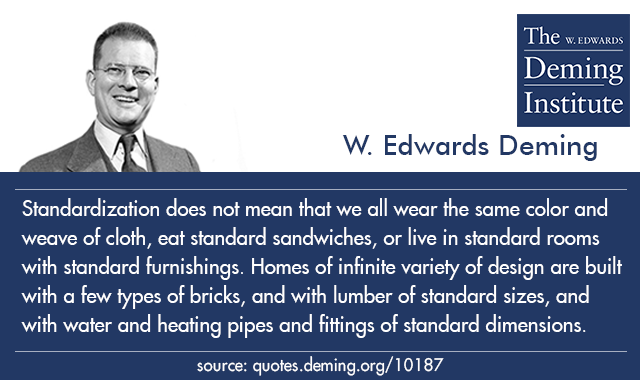
quote text: Standardization does not mean that we all wear the same color and weave of cloth, eat standard sandwiches, or live in standard rooms with standard furnishings. Homes of infinite variety of design are built with a few types of bricks, and with lumber of standard sizes, and with water and heating pipes and fittings of standard dimensions.

Dr. Deming understood the organization as a system and how understanding variation fit within that system. When variation within the system causes problems and reduces efficiency then reducing variation important. It is a mistake to attempt to take thinking that is part of a system and analyze it without understanding the context within which it has meaning. Reducing variation has a specific context within Deming's thinking and that did not mean reducing variety or reducing variation when it was useful.

W. Edwards Deming understood you didn't use the same improvement thinking every time you wanted to improve. You selected the useful management tools and concepts that fit the current situation. It is important to have a wide variety of tools and thinking to allow finding the best ways to improve different situations.

Iteration is an extremely important part of improvement efforts. Why? Because, trying a variety of ways to improve and a variety of changes to the existing conditions will lead to finding the most valuable improvements. The PDSA improvement cycle is designed specifically to introduce more variation into improvement experiments. The value of many small attempts using different tactics (introducing variation to learn what works best) is a core part of a Deming management system.

W. Edwards Deming stressed the importance of understanding psychology and appreciating how different people provided important contributions and how that variety helped the organization. You need to design systems to maximize the benefit gained due to some forms of variation.

It is a mistake to think that W. Edwards Deming didn't understand the value of variety or of variation in the right context. One must reduce the variation that is damaging to the ability of a system to deliver reliable value to customers. That doesn't mean variety and variation in other contexts are not understood to be valuable.

Related: How to Improve Your Understanding Variation and to Use Data to Improve - We Need to Understand Variation to Manage Effectively - Standardization Doesn’t Stamp Out Creativity

This is an edited comment I wrote in response to post on Linked In but since they have repeatedly broken links over the years I don't link to that site any more.

Monday, May 07, 2018

Learning from Gemba Walks

comment on: What’s the Right Way to Do a Gemba Walk?

Well said. Both "treating people as individuals and showing them respect" and "learning how they wish to influence outcomes in their lives and work" are very important. I also think one of the keys that makes gemba walks valuable is for the person doing the walk truly seeking to learn; a curiosity about the nature of the work at this particular gemba seems present in those that make it a valuable process (that curiosity continues and grows it isn't satisfied on a walk instead it is stoked to encourage more learning).

Related: Deming Wanted Managers to Understand the Systems They Managed and to Visit Where the Work was Done - Gemba Keiei by Taiichi Ohno - Out of Touch Executives Damage Companies: Go to the Gemba

Sunday, April 22, 2018

The Importance of Explicit Communication

comments on Ten Tips for Improving Communication

I would add make communication explicit, relying on implicit communication often leads to problems.

Another good things to remember is that you know what you said, but you don't know what someone else hears and understands. Making things explicit reduces the opportunities for misunderstandings.

Related: The Use and Misuse of Technical Jargon - Simple Customer Care: Communicate - Checklists Save Lives

Wednesday, March 14, 2018

The Management System is the Key

Comments on: Lean is All About People – Or is It?

I think there are a number of necessary conditions and without them even whatever people think is the most important don't make the difference. The interactions between the components are extremely important. Rather than the analytic view to focus on individual pieces I think the key to a good management system is a focus on the organization as a system. That requires an organization that is: customer focused, continual improving with a respect for people.

Related: How to Create a Continual Improvement Culture - Give People Enough Rope (and the Right Rope) to Achieve - Management Matters: Building Enterprise Capability - Engage in Improving the Management System

Follow up comment (to another comment made on the blog):

But it doesn’t offer a very easy handle for people to grasp. The so-called lean system is actually a set of systems, quite complex when you map it out.

I agree. It is helpful to make things simple to appreciate and understand – bearing in mind of course:

“Everything should be made as simple as possible, but not simpler.”

I think too often people (in relation to management ideas) demand that things be made more simple than is possible to adequately understand the systems involved. This of course leads to problems. A huge value provided by people like Russell Ackoff is their ability to help explain what is needed in fairly simple terms. Still understanding how these ideas are being expressed in our management systems and how to apply the concepts to our management systems is still a challenge.

Good lean thinking (lean manufacturing…) efforts do a great deal to help this process. Even when they oversimplify (which I think is often) they get closer to appreciating the overall management system than nearly any other management framework. I believe it is possible to make things “more simple than possible” more effectively than other instances of making things “more simple than possible.” I think one of the big differences between the best lean efforts and the others is the increased value placed on deeper understanding and thinking systemically.

I do believe you often have to start with overly simplified explanations and concepts as you introduce management improvement concepts to new organizations. This is often done, and it is sensible. The problem I see is alms never is it understood this is what is happening and there is no effort to build the capability of the organization to grow the management system into one with people that gain a deeper understanding of the tools, skills, ideas and concepts.

Wednesday, January 31, 2018

Avoiding Difficult Problems

Response to: Toyota is Admired for Good Reason… But About Those Rotating Job Shifts…

Thanks for another good post. It points out that while Toyota does many things very well they have opportunities to improve. And I am sure they agree they have a huge number of things to improve.

I agree, this rotating shifts seems like something important to try and improve. One of the things that happens in many organizations is that working on things that are going to make lots of people mad are often avoided. This rotating shift work seems like something that is likely to make people upset.

Even if you worked on improving it, likely during those PDSA cycles many people would be annoyed. And if you were working on it, you could get blamed, you could be tarnished as someone people didn't like it and didn't appreciate "you doing this to them." If, on the other hand, no one is making significant efforts to improve, even if people are annoyed it is at some amorphous policy and usually doesn't stick to 1 person.

If the dis-satisfaction does accumulate toward 1 person (say the plant manager) that person then often will push through and deal with it - or assign someone to deal with it and stay on them to make sure they do the difficult work (even if doing so will make that person's life much more difficult).

Now I would hope Toyota is better managed than that and doesn't shy away from important work just because the people that would take the lead have strong reasons to avoid working on that task.

There are often so many things to improve that it isn't too hard to shift the focus away from something that no one wants to take on. Sometimes though things are so important they must be taken on. Usually those would be more direct and obvious problems. Systemic problems that cause great damage but in a less visible way (such as rotating job shifts) are less likely to be addressed.

Coping with this issue (of avoiding unpleasant, systemic and long term rather than acute problems) is one of the things that separates great corporate culture from decent or bad corporate culture.

If there are fairly obvious or fairly easy improvements those would likely be acted on. There are, rarely, but still sometimes, instances where those vocal or politically powerful individuals who would lose out in a fairly obvious improvement will prevent action.

I am pretty sure Toyota doesn't have fairly easy improvements on this issue, that they must realize is important, that they are just not getting to. I am a bit less confident that Toyota isn't avoiding trying to find solutions using a PDSA type effort because it would be really hard and risky work for whoever takes it on. Also Toyota can try to rely on the good will built up through their many efforts to expect enough employees to say that they will accept the suffering caused by this policy for the good of the everyone.

I am not convinced there are not ways to improve the situation. And I am pretty confident it is important enough to try. And I believe (though I might be wrong) with a concerted effort of knowledgable people improvements that would make a big difference in the quality of life could be achieved. I am not so certain those people involved in leading the effort would be seen in great lights though even if they "succeed." People are much more likely to remember negative consequences to them personally, even if they gain much more than they lost overall. And most will remember the effort negatively if they lost only a little but overall the gains (to the overall organization) were much bigger: in such cases many will hold onto feelings that they were harmed by those that took action.

Related: Respect for People Doesn’t Mean Avoiding Any Hint of Criticism - The Importance of Critical Thinking and Challenging Assumptions - Unpacking the Components of Hard Work to Design Better Work Conditions

Tuesday, December 12, 2017

Failing to Adopt Better Methods is Sadly a Common Management Practice

comment on Is Andre Drummond a Better Free Throw Shooter This Season?
Using "Process Behavior Charts" to Answer This Question

There is also a fairly convincingly better method to shoot free throws - underhanded. As I stated in my post, Why Do People Fail to Adopt Better Management Methods?

People can be very attached to the way things have always been done. Or they can just be uncomfortable with the prospect of trying something new.
...
Wilt Chamberlain was 28 for 32 from the line shooting underhanded in his 100 point game (the most points anyone has scored in a NBA basketball game).

He was a career 51% free throw shooter (almost entirely shooting traditionally).

But he had a good reason not to use underhand style more often. He felt like a sissy using that style and making them. I am sure the Boston Celtics were happy to let him focus on being scared of looking foolish while they won championships. You are correct if you don’t think I really meant he had a good reason.

This reluctance to use better methods is not limited to underhanded free throw shooting. Managers fail to adopt better management methods every day that are equivalent to failing to improve free throw results using a proven method.

Wednesday, September 20, 2017

Coaching: Helping People Improve the Results of the System

Comments on: Lean Quote: Coaching is about...Others

I wouldn't put it as "their own problems and improve their own performance." I do agree it is about helping others. But especially for management I think it is more about helping people improve the results of the overall system.

That does include helping them grow and improve their capabilities. But a huge part of what is holding back the performance of our organizations is the limited understanding of how to improve the overall system. Just improving yourself doesn't necessarily improve the overall results.

In a similar way an athletic coaches focus is on how to improve the team. A big part of that is how to improve each team member but the interactions (how everything works together) are often more important than the individual improvements.

It is important to give people the tools they need to understand how to improve the system including how they fit and how important interactions are within a system.

Related: Helping Employees Improve - Manage the System to Take Advantage of the Strengths Each Person Has - Lessons for Managers from Wisconsin and Duke Basketball - The Psychology of Change is Often the Trickiest Part of Process Improvement

Thursday, September 14, 2017

Quit Looking for Silver Bullets and Get to Work Improving Management

My comments on There Are No Silver Bullets:

It is somewhat amazing that nearly everyone would agree with the sentiment that there are no silver bullets but if you evaluate what they seek for management improvements they want silver bullets :-(

If you like to find the silver lining amidst clouds this tendency to want magic solutions means that you can make great progress if you are willing to do the work. Others are not using well known management improvement strategies not because they don't work but because they are not silver bullets.

Related: Why Use Lean if So Many Fail To Do So Effectively - The Quick Fix Doesn't Exist - Everyone wants instant pudding

Thursday, September 07, 2017

People and Robots Together

Comments on: The Coming Auto Industry Battle: Toyota’s People vs. Tesla’s Robots?

Toyota's method is the best and will continue to be.

However, I believe we have reached a turning point where the effectiveness of industrial robots has greatly improved. For several decades it was pretty easy to predict wholesale adoption of the robots will save us mantra would be followed by failure. I still strongly believe Toyota's method (thoughtful use of robotics to enhance people is the best strategy). But the ease of using robots to succeed in the long term is much enhanced these days.

Robot first strategies are going to be succeeding quite a bit going forward. Yes those efforts might not be good enough when competing only with companies using the best strategy well (but that will be rare).

I wrote some about this in a recent blog post: Technological innovation brings great opportunity for improving results and our quality of life. But transforming potential benefits into real results comes with many challenges...

Essentially I see people today too dismissive of the usefulness of industrial robots. And they have past examples to point to in showing how a large commitment to robot first failed. It isn't that today robot first is the best strategy but I do believe the real world conditions have improved to make the blanket assumption that such efforts will fail as unwise.

A big part of this is that while we can simplify the argument to "robot first" or "robots helping people" it really isn't that simple. There are many reasons why today the conditions are different than they have been. Technological and software improvements are a big part of that. But also there is more thoughtful consideration of the advantages Toyota's management philosophy brings. Sadly not enough, but still companies are better today at thinking and acting as if their employees have brains than they were 30 years ago. Granted there is still a long way to go, but still progress has been made it seems to me at the macro level.

Related: GMs huge investment in robotics in the 1980s ($billions) has been an example of how pinning hopes on technology often doesn’t produce the desired results. - Toyota Develops Thought-controlled Wheelchair - Two resources, largely untapped in American organizations, are potential information and employee creativity.

Tuesday, August 29, 2017

Leading Change in the Face of Fear

Comments on the comments related to "How to Combat Fear" podcast with Ron Pereira

"whose skepticism will override the possibility that a change will actually be an improvement"

This feeling is often the result of many previous changes promoted as improvements that were not successful. Most people learn to be skeptical of management claims (sure a few people are pre-disposed to thinking this way but for many more it is a learned response).

I would add to the idea that we need to work with those more willing to try new ideas (early adopters) that last we need to have visible success with those early adopters to gain evidence that this time is different.

Related: Transforming a Management Culture - How to Help Instigate Change in an Organization - The Sociology of Organizational Change

Tuesday, August 01, 2017

Wednesday, July 19, 2017

Code Software to be Robust and Easy to Update Quickly

Comment on: Correction vs Prevention in Software Development

I think both prevention and designing the software and management system so that rapid correction is possible are important. While rare events may be difficult to prevent when looking at each instance there are styles of coding that make more "edge case" failures more likely. Coding so that the system is as robust as possible is wise but you should also realize those efforts will likely not be perfect and so designing in visible notifications of failure and coding so rapid correction is possible is necessary.

In addition to the need to update quickly for bugs, software should be easy to update due to changing requirements and to aid in continual improvement efforts.

Related: Improving Software Development with Automated Tests - Software Supporting Processes Not the Other Way Around - Building a System to Reduce Interruptions for Software Developers
- Use Urls: Don’t Use Click x, Then Click y, Then Click z Instructions

Wednesday, July 12, 2017

Earning the Trust of Employees

My comments on: Why good employees (should not) leave (good companies)? – The employer perspective

One of the very challenging tasks as a manager is to get people to trust bringing up difficult topics. Often people are punished for doing so. Most people learn to keep quiet about management problems. Even when managers say they want to hear there are many instances when they then punish those who speak up.

I agree with you that for organizations to flourish management must know what needs to be improved. But few executives or managers put in the effort to earn people's trust. But building that trust is what organizations that want to flourish need to do.

Related: Ignoring Unpleasant Truths is Often Encouraged - How to Create a Continual Improvement Culture - Practical Ways to Respect People - The Problem is Likely Not the Person Pointing Out The Problem - Build an Environment Where Intrinsic Motivation Flourishes

Tuesday, July 04, 2017

Using Money to Motivate Creates More Problems Than Benefits

Comments on: Employee Motivation and Lean Implementation – Part 2: Money

Well said. Nearly all "motivation" efforts such as bonuses create far more problems than benefits. Paying people fairly is important, if they don't have enough to live they will be distracted and seeking new options.

And if they are substantially underpaid compared to the market (even if they have enough to live comfortably) they will be prone to seek new alternatives and be disgruntled because they feel they are being treated unfairly.

The best "motivation" managers can provide is to eliminate the de-motivation created by poor practices in the management system.

Sadly these are often common and managers can keep themselves very busy just doing this. If not, they are likely very lucky and probably have no motivation problems to worry about.

Related: Why Extrinsic Motivation Fails - The Defect Black Market - Dangers of Extrinsic Motivation - Extrinsic Incentives Kill Creativity - A "Demotivated" Workforce is a Symptom of the Culture of the Organization - The Potential Benefits, Risks and Folly of Stretch Goals

Wednesday, June 28, 2017

Systems Thinking and Management Improvement

This is a response to a comment on my own blog post: Peter Senge on Systems Thinking

Great video on systems. It seems systems thinkers believe it to be a cure all. Deming’s addition of psychology, epistemology, and statistics and interactions is so much more powerful. What do you think? Is it all Japan needed because they had the other elements? Do we need more?

Senge has very good ideas. I would add to his thoughts more of what Deming, Scholtes, Joiner... said. I think many people get into the idea that their areas of interest is nearly everything that is needed.

I don't think Japan just needed systems thinking (for one thing there organizations start with more of that understanding). For another, a real problem in Japan is going along and not speaking up about problems. That is an issue everywhere but is much worse in Japan than the West. Japan has an obsession with customer service that would be valuable for USA organizations to learn from.

A big part of what makes Deming's framework so useful is he was continually learning and adopting new ideas (Senge does a lot of this compared to most people but I can't think of anyone in the Management area that is close to as good as Deming was at this). I do think most Deming folks today would benefit greatly from much more thinking a about the organization as a system. It is often very superficial in my experience (repeating phrases like "we need to break down barriers between departments" or "it is a mistake to optimize the part because it sub-optimizes the whole"). Those ideas are great but you need to manage based on that concept not just say it and move on.


I can't remember if I have added a comment from my own blog here before :-/

Related: Why Do People Fail to Adopt Better Management Methods? - Leadership While Viewing the Organization as a System - A Good Management System is Robust and Continually Improving

Tuesday, May 16, 2017

Transforming a Management Culture

Thoughts on: Where Lean Went Wrong – A Historical Perspective

I believe that companies that say they are attempting to become lean fail to do so in the most important ways. I do believe most efforts result in improvement but usually are fairly limited by the existing management system and refusal to really change much.

More than "lean failing" I would say transforming to a different management culture fails. Saying lean fails makes it seem to me that what a lean management system was in use and failed which is not really the case it doesn't seem to me.

I wrote about these ideas on my blog: Why Use Lean if So Many Fail To Do So Effectively

and discussed them in this podcast on Building Organizational Capability.

Related: Why Do People Fail to Adopt Better Management Methods? - Transforming a Management System – A Case Study From the Madison Wisconsin Police Department - Culture Change Requires That Leaders Change Their Behavior - Change Management: Create a Culture Seeking Continual Improvement or Use Band-Aids?