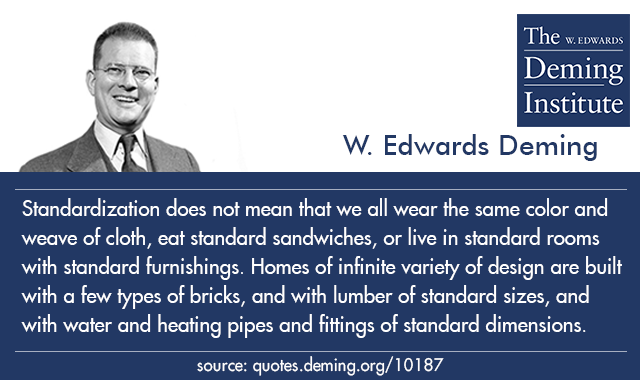
It doesn't follow that because Dr. Deming sought to reduce the variation that caused processes to be unreliable and that harmed customers it meant he was against variety or failed to understand the importance of variation in different contexts than the context where it caused problems. Drawing such a conclusion is just not sensible when looking at Deming's work. It is a misunderstanding that is usually caused by taking one quote and drawing poor conclusions about what that quote meant.
Dr. Deming understood the organization as a system and how understanding variation fit within that system. When variation within the system causes problems and reduces efficiency then reducing variation important. It is a mistake to attempt to take thinking that is part of a system and analyze it without understanding the context within which it has meaning. Reducing variation has a specific context within Deming's thinking and that did not mean reducing variety or reducing variation when it was useful.
W. Edwards Deming understood you didn't use the same improvement thinking every time you wanted to improve. You selected the useful management tools and concepts that fit the current situation. It is important to have a wide variety of tools and thinking to allow finding the best ways to improve different situations.
Iteration is an extremely important part of improvement efforts. Why? Because, trying a variety of ways to improve and a variety of changes to the existing conditions will lead to finding the most valuable improvements. The PDSA improvement cycle is designed specifically to introduce more variation into improvement experiments. The value of many small attempts using different tactics (introducing variation to learn what works best) is a core part of a Deming management system.
W. Edwards Deming stressed the importance of understanding psychology and appreciating how different people provided important contributions and how that variety helped the organization. You need to design systems to maximize the benefit gained due to some forms of variation.
It is a mistake to think that W. Edwards Deming didn't understand the value of variety or of variation in the right context. One must reduce the variation that is damaging to the ability of a system to deliver reliable value to customers. That doesn't mean variety and variation in other contexts are not understood to be valuable.
Related: How to Improve Your Understanding Variation and to Use Data to Improve - We Need to Understand Variation to Manage Effectively - Standardization Doesn’t Stamp Out Creativity
This is an edited comment I wrote in response to post on Linked In but since they have repeatedly broken links over the years I don't link to that site any more.
This now serves as a blog to collect some of the comments I make on other blogs related to management improvement (Deming, lean thinking, six sigma, leadership, systems thinking, respect for people...). Read my main management blog: Curious Cat Management Improvement Blog
Showing posts with label Deming. Show all posts
Thursday, May 17, 2018
Tuesday, July 04, 2017
Using Money to Motivate Creates More Problems Than Benefits
Comments on: Employee Motivation and Lean Implementation – Part 2: Money
Well said. Nearly all "motivation" efforts such as bonuses create far more problems than benefits. Paying people fairly is important, if they don't have enough to live they will be distracted and seeking new options.
And if they are substantially underpaid compared to the market (even if they have enough to live comfortably) they will be prone to seek new alternatives and be disgruntled because they feel they are being treated unfairly.
The best "motivation" managers can provide is to eliminate the de-motivation created by poor practices in the management system.
Sadly these are often common and managers can keep themselves very busy just doing this. If not, they are likely very lucky and probably have no motivation problems to worry about.
Related: Why Extrinsic Motivation Fails - The Defect Black Market - Dangers of Extrinsic Motivation - Extrinsic Incentives Kill Creativity - A "Demotivated" Workforce is a Symptom of the Culture of the Organization - The Potential Benefits, Risks and Folly of Stretch Goals
Well said. Nearly all "motivation" efforts such as bonuses create far more problems than benefits. Paying people fairly is important, if they don't have enough to live they will be distracted and seeking new options.
And if they are substantially underpaid compared to the market (even if they have enough to live comfortably) they will be prone to seek new alternatives and be disgruntled because they feel they are being treated unfairly.
The best "motivation" managers can provide is to eliminate the de-motivation created by poor practices in the management system.
Sadly these are often common and managers can keep themselves very busy just doing this. If not, they are likely very lucky and probably have no motivation problems to worry about.
Related: Why Extrinsic Motivation Fails - The Defect Black Market - Dangers of Extrinsic Motivation - Extrinsic Incentives Kill Creativity - A "Demotivated" Workforce is a Symptom of the Culture of the Organization - The Potential Benefits, Risks and Folly of Stretch Goals
Wednesday, June 28, 2017
Systems Thinking and Management Improvement
This is a response to a comment on my own blog post: Peter Senge on Systems Thinking
Senge has very good ideas. I would add to his thoughts more of what Deming, Scholtes, Joiner... said. I think many people get into the idea that their areas of interest is nearly everything that is needed.
I don't think Japan just needed systems thinking (for one thing there organizations start with more of that understanding). For another, a real problem in Japan is going along and not speaking up about problems. That is an issue everywhere but is much worse in Japan than the West. Japan has an obsession with customer service that would be valuable for USA organizations to learn from.
A big part of what makes Deming's framework so useful is he was continually learning and adopting new ideas (Senge does a lot of this compared to most people but I can't think of anyone in the Management area that is close to as good as Deming was at this). I do think most Deming folks today would benefit greatly from much more thinking a about the organization as a system. It is often very superficial in my experience (repeating phrases like "we need to break down barriers between departments" or "it is a mistake to optimize the part because it sub-optimizes the whole"). Those ideas are great but you need to manage based on that concept not just say it and move on.
I can't remember if I have added a comment from my own blog here before :-/
Related: Why Do People Fail to Adopt Better Management Methods? - Leadership While Viewing the Organization as a System - A Good Management System is Robust and Continually Improving
Great video on systems. It seems systems thinkers believe it to be a cure all. Deming’s addition of psychology, epistemology, and statistics and interactions is so much more powerful. What do you think? Is it all Japan needed because they had the other elements? Do we need more?
Senge has very good ideas. I would add to his thoughts more of what Deming, Scholtes, Joiner... said. I think many people get into the idea that their areas of interest is nearly everything that is needed.
I don't think Japan just needed systems thinking (for one thing there organizations start with more of that understanding). For another, a real problem in Japan is going along and not speaking up about problems. That is an issue everywhere but is much worse in Japan than the West. Japan has an obsession with customer service that would be valuable for USA organizations to learn from.
A big part of what makes Deming's framework so useful is he was continually learning and adopting new ideas (Senge does a lot of this compared to most people but I can't think of anyone in the Management area that is close to as good as Deming was at this). I do think most Deming folks today would benefit greatly from much more thinking a about the organization as a system. It is often very superficial in my experience (repeating phrases like "we need to break down barriers between departments" or "it is a mistake to optimize the part because it sub-optimizes the whole"). Those ideas are great but you need to manage based on that concept not just say it and move on.
I can't remember if I have added a comment from my own blog here before :-/
Related: Why Do People Fail to Adopt Better Management Methods? - Leadership While Viewing the Organization as a System - A Good Management System is Robust and Continually Improving
Thursday, May 25, 2017
Interactions Among the Four Fields in Deming's System of Profound Knowledge
Question on Reddit:
I would like to see expansion of Deming's SoPK with more examples of interactions in the four fields of knowledge. Are you aware of any?
My response:
I think this is actually very common, but often it isn't explicitly mentioned. To explain this well would take a fair amount of time. Let me just give 2 quick examples
Distorting the System to meet a target
This certainly is about the interaction of understanding variation (in this case people not understanding data well enough and being mislead), psychology (how people respond to pressure to meet goals), theory of knowledge (not understanding the difference between the proxy value of data and the underlying truth) and systems thinking (how a system is likely to react to meet goals - distorting data and distorting the system, and using simple measures where those things work to get numbers).
Create a System That Lets People Take Pride in Their Work
Appreciating that results will be better when people are doing work they are proud of involves at least appreciation
for a system and psychology.
I think in reality nearly every example involves interactions. We can analytically separate out the one we want to discuss or the one that seems most influential in what we are looking at but in reality it isn't just one.
For example, data issues related to over-reacting to common cause variation is in the "understanding variation" realm. But it is also deeply ingrained in our psychology that we look for special causes. If our psychology was different it is very possible the mistake of "seeing" (and believing) special causes everywhere would not be a problem. But because those 2 area interact in the way they do it is an area of improvement for how we think and manage. By focusing on an understanding of variation we can limit the damage caused by are faulty psychology (seeing special causes where they don't exist - where it is just common causes). And that really integrates theory of knowledge and systems thinking (we chronically over-simplfy and ignore the large system).
Related: 94% Belongs to the System - Encourage Improvement Action by Everyone - Circle of Influence
I would like to see expansion of Deming's SoPK with more examples of interactions in the four fields of knowledge. Are you aware of any?
My response:
I think this is actually very common, but often it isn't explicitly mentioned. To explain this well would take a fair amount of time. Let me just give 2 quick examples
Distorting the System to meet a target
This certainly is about the interaction of understanding variation (in this case people not understanding data well enough and being mislead), psychology (how people respond to pressure to meet goals), theory of knowledge (not understanding the difference between the proxy value of data and the underlying truth) and systems thinking (how a system is likely to react to meet goals - distorting data and distorting the system, and using simple measures where those things work to get numbers).
Create a System That Lets People Take Pride in Their Work
Appreciating that results will be better when people are doing work they are proud of involves at least appreciation
for a system and psychology.
I think in reality nearly every example involves interactions. We can analytically separate out the one we want to discuss or the one that seems most influential in what we are looking at but in reality it isn't just one.
For example, data issues related to over-reacting to common cause variation is in the "understanding variation" realm. But it is also deeply ingrained in our psychology that we look for special causes. If our psychology was different it is very possible the mistake of "seeing" (and believing) special causes everywhere would not be a problem. But because those 2 area interact in the way they do it is an area of improvement for how we think and manage. By focusing on an understanding of variation we can limit the damage caused by are faulty psychology (seeing special causes where they don't exist - where it is just common causes). And that really integrates theory of knowledge and systems thinking (we chronically over-simplfy and ignore the large system).
Related: 94% Belongs to the System - Encourage Improvement Action by Everyone - Circle of Influence
Saturday, August 27, 2016
How to Help Instigate Change in an Organization
My comments on The W. Edwards Deming Institute blog in response to:
Thanks for your comments. We will certainly address those topics in future posts.
We have explored some similar ideas in the past, here are some links that may be useful.
Dr. Deming "Statistical principles and techniques must be rooted and nourished with patience, support, and recognition from top management."
I don't think there are simple answers to your questions that take the form of do this simple thing and what concerns you is taken care of right away. You need to work with what you can and gain credibility so people are more and more willing to listen to you. Transforming the Organization – Deming Podcast with David Langford has some good ideas.
I have written about the questions you bring up on my Curious Cat Management blog: Habits and What to Do To Create a Continual Improvement Culture.
My basic philosophy is that the way to do what you are asking is to help people improve and while doing so explain how it relates to the points you mention (fear caused the problem we had to fix...). Few believe you at first. After you help numerous times more people start to believe maybe the overall philosophy actually is worth listening to since you seem to be able to make things better and you keep tying it back to view the organization as a system, understanding variation (and what data can and cannot tell you...), etc..
I’d like to see some posts about how to implement change in an organization. How does one get an organization to start looking at itself as a system? How does one get the organization to realize that the most important figures are unknown and unknowable? How does one convince an organization the importance of driving out fear? In short, how does one get an organization to listen to what Deming had to say?
Thanks for your comments. We will certainly address those topics in future posts.
We have explored some similar ideas in the past, here are some links that may be useful.
Dr. Deming "Statistical principles and techniques must be rooted and nourished with patience, support, and recognition from top management."
I don't think there are simple answers to your questions that take the form of do this simple thing and what concerns you is taken care of right away. You need to work with what you can and gain credibility so people are more and more willing to listen to you. Transforming the Organization – Deming Podcast with David Langford has some good ideas.
I have written about the questions you bring up on my Curious Cat Management blog: Habits and What to Do To Create a Continual Improvement Culture.
My basic philosophy is that the way to do what you are asking is to help people improve and while doing so explain how it relates to the points you mention (fear caused the problem we had to fix...). Few believe you at first. After you help numerous times more people start to believe maybe the overall philosophy actually is worth listening to since you seem to be able to make things better and you keep tying it back to view the organization as a system, understanding variation (and what data can and cannot tell you...), etc..
Friday, February 05, 2016
The Absence of Defects Does Not Necessarily Build Business
Comment on: Saving Money vs Making Money
How about Deming's thoughts :-)
"No defects, no jobs. Absence of defects does not necessarily build business… Something more is required." W. Edwards Deming
Waste can be equated to defects and the sentiment is the same. I share more of my thoughts on the topic in a 2006 post: Quality and Innovation.
Related: Zero Defects Isn't the Right Goal - Customer Focus by Everyone
by saving money, we make more money – simple (and easy); anyone should be able to see that! And while this may be true for the short term, it doesn’t support any longer term growth.
...
So, what do you want to do? Do you want to save money or make money?
Let me know your thoughts!
How about Deming's thoughts :-)
"No defects, no jobs. Absence of defects does not necessarily build business… Something more is required." W. Edwards Deming
Waste can be equated to defects and the sentiment is the same. I share more of my thoughts on the topic in a 2006 post: Quality and Innovation.
Related: Zero Defects Isn't the Right Goal - Customer Focus by Everyone
Monday, January 11, 2016
Don't Use Targets as a Management Tool
comments on: Deconstructing Deming XI B – Eliminate numerical goals for management
I agree with the comments that targets are unwise. There is one sense in which I think the idea of (but not actual) targets can be useful and that is in setting the scope.
If we want to find an improvement that is immense (versus small continual improvement) that can set the expectation of how we approach improvement, including an understanding that we are going to have to really make big changes in how things are done.
I have written more about this, here:
Deming on Targets
Basically I don't see that scoping "target" as really a target but it is similar so if you want to see it that way, then in that sense I can see a "target" as useful.
Related: Innovation at Toyota - Targets Distorting the System - Righter Incentivization
I agree with the comments that targets are unwise. There is one sense in which I think the idea of (but not actual) targets can be useful and that is in setting the scope.
If we want to find an improvement that is immense (versus small continual improvement) that can set the expectation of how we approach improvement, including an understanding that we are going to have to really make big changes in how things are done.
I have written more about this, here:
Deming on Targets
Basically I don't see that scoping "target" as really a target but it is similar so if you want to see it that way, then in that sense I can see a "target" as useful.
Related: Innovation at Toyota - Targets Distorting the System - Righter Incentivization
Tuesday, December 01, 2015
Quality Digest: How to Create a Culture of Continuous Improvement
Quality Digest published my article: How to Create a Culture of Continuous Improvement
Related: Change and the Management System - John Hunter online - Lowering Expectations Isn't Showing Respect
Tuesday, June 02, 2015
Learning From Process Improvement Efforts
Comment on: How to Improve (at just about anything)
Another huge benefit to the PDSA cycle in my experience is to learn. I can't remember how many times I would see in the do-do-do-do organization that
do#1 was x
do#2 was y
do#3 was x again
do#4 was z
do#5 was y again
Um, ok, yeah why are we trying things we already know don't work (they are presented as fixes not, as well this old way wasn't great but jeez it was much less bad than the mess we have now so lets go back). Why are we thinking x is going to work when we just dumped x because it wasn't working? PDSA makes you think about the process, study the historical data and document your predictions. The learning will
Related: How to Improve - Document Your Decisions to Learn More Effectively - Learn by Seeking Knowledge, Not Just from Mistakes - Write it Down
1. The classic way:
Do – make an improvement
Do – change a process
Do – implement some training
Do – install a system
When you have been through the 4 do’s keep right on doing.
2. The recommended way:
Plan – develop an idea or innovation, work out how you will implement it.
Do – carry out the plan on a small-scale, test it to see if it works.
Check – study what happened, did the plan work? If not why not? What can you change?
Act – adopt the change and roll it out, abandon it or learn from it and adapt it.
Another huge benefit to the PDSA cycle in my experience is to learn. I can't remember how many times I would see in the do-do-do-do organization that
do#1 was x
do#2 was y
do#3 was x again
do#4 was z
do#5 was y again
Um, ok, yeah why are we trying things we already know don't work (they are presented as fixes not, as well this old way wasn't great but jeez it was much less bad than the mess we have now so lets go back). Why are we thinking x is going to work when we just dumped x because it wasn't working? PDSA makes you think about the process, study the historical data and document your predictions. The learning will
Related: How to Improve - Document Your Decisions to Learn More Effectively - Learn by Seeking Knowledge, Not Just from Mistakes - Write it Down
Tuesday, May 19, 2015
Deming Wanted Managers to Understand the Systems They Managed and to Visit Where the Work was Done
Comments on Deming wasn’t a fan of Management by Walking Around
True, and the details you provide are important. It wasn't managers going to the gemba Deming was against. What mattered is the system. Some people did Management by Walking Around (MBWA), even decades ago, in a useful way - with understanding. But most did not.
Gemba walks are much more likely to be useful (because the expectations are for a more engaged leader) but there are plenty of times those are not done well, and are no better than bad MBWA. Jim Womack has a book out on Gemba Walks which provides good details to managers on what they should do (and what Deming wanted them to do).
Related: Out of Touch Executives Damage Companies, Go to the Gemba - Leadership and Management - Jeff Bezos Spends a Week Working in Amazon’s Kentucky Distribution Center (2009) - Customer Gemba
Deming’s view is entrenched in Lean management practice in the form of “Genchi Genbutsu”, literally “go and see” at the “real place”. Where practitioners of Management by Walking Around merely visit the workers for a chat, practitioners of Genchi Genbutsu stay with the workers to understanding what is going on.
True, and the details you provide are important. It wasn't managers going to the gemba Deming was against. What mattered is the system. Some people did Management by Walking Around (MBWA), even decades ago, in a useful way - with understanding. But most did not.
Gemba walks are much more likely to be useful (because the expectations are for a more engaged leader) but there are plenty of times those are not done well, and are no better than bad MBWA. Jim Womack has a book out on Gemba Walks which provides good details to managers on what they should do (and what Deming wanted them to do).
Related: Out of Touch Executives Damage Companies, Go to the Gemba - Leadership and Management - Jeff Bezos Spends a Week Working in Amazon’s Kentucky Distribution Center (2009) - Customer Gemba
Wednesday, May 13, 2015
What is a Lean Program, Deming Program?
Thoughts in response to: Dr. Deming’s Last Interview & Jack Welch’s Thoughts on Him by Mark Graban.
Deming sure provided some great quotes in that interview; those you listed above and more (in fact I posted about one this week in To Achieve Success Focus on Improving the System Not On Individual Performance). From Mark's post:
This is so true. Basically organizations can be making good progress but essentially none that *have* a Deming or lean program. Toyota is sensible to consider the closest - I mean lean after all originally was just documenting Toyota and calling it lean instead of Toyota management or whatever. But Toyota does plenty of things that are not what even Toyota says how things should be done.
And beyond that lean has evolved away, IMO, from just being able to say anything Toyota does is by definition lean. Lean and Deming are more about a philosophy of managing - continual improvement, respect for people, etc. than prescriptions. So you can't really have a checklist and say that if your org can check off all these things they are lean or Deming.
The fact that the management systems can't be reduced to a checklist is a necessary given the long lasting power they offer. When you reduce the ideas for management that far (so you have a checklist of exactly what to do) you get a stupid system that can't be used for managing large systems of people. Organizations doing the best job of being worth of claims of being true to the management systems are likely to have the widest understanding of all the ways in which they are failing to live up to that vision.
I continue to think Toyota is doing a very good job. But they also have plenty of room to improve. And they continue to be tempted by becoming more like other companies instead of recommitting to the principles of lean and Deming.
Related: Rethinking or Moving Beyond Deming Often Just Means Applying More of What Dr. Deming Actually Said - Long Term Thinking with Respect for People - Deming and Software Development
Deming sure provided some great quotes in that interview; those you listed above and more (in fact I posted about one this week in To Achieve Success Focus on Improving the System Not On Individual Performance). From Mark's post:
I’m not sure what 'a Deming program' is anymore than I know what 'a Lean program' is sometimes.
This is so true. Basically organizations can be making good progress but essentially none that *have* a Deming or lean program. Toyota is sensible to consider the closest - I mean lean after all originally was just documenting Toyota and calling it lean instead of Toyota management or whatever. But Toyota does plenty of things that are not what even Toyota says how things should be done.
And beyond that lean has evolved away, IMO, from just being able to say anything Toyota does is by definition lean. Lean and Deming are more about a philosophy of managing - continual improvement, respect for people, etc. than prescriptions. So you can't really have a checklist and say that if your org can check off all these things they are lean or Deming.
The fact that the management systems can't be reduced to a checklist is a necessary given the long lasting power they offer. When you reduce the ideas for management that far (so you have a checklist of exactly what to do) you get a stupid system that can't be used for managing large systems of people. Organizations doing the best job of being worth of claims of being true to the management systems are likely to have the widest understanding of all the ways in which they are failing to live up to that vision.
I continue to think Toyota is doing a very good job. But they also have plenty of room to improve. And they continue to be tempted by becoming more like other companies instead of recommitting to the principles of lean and Deming.
Related: Rethinking or Moving Beyond Deming Often Just Means Applying More of What Dr. Deming Actually Said - Long Term Thinking with Respect for People - Deming and Software Development
Wednesday, April 15, 2015
Did Deming and Drucker Agree on Important Management Practices?
Response to, Help needed fleshing out differences between Drucker & Deming? on The W. Edwards Deming Institute LinkedIn group.
Here are some links about the topic
Drucker did propose MBO, his version was not the same thing we criticize. Drucker did criticize how it was being implemented. I think you can argue even with the way Drucker wanted it done, but that way isn't nearly as bad as the way it was done in practice (so don't think Drucker was promoting managing in the way MBO has often been practiced).
And also don't tie Drucker to just MBO, he had lots of ideas over a very long career and many work fine with a Deming management system. I think in many ways Drucker's stuff can be more easily molded to whatever someone wants it to be - this is one reason I think you see Drucker taught in business school. They can claim Drucker wouldn't object to many things, even though, really I think he would - I am not sure Drucker spoke out so directly (especially compared to Deming).
But Drucker was direct on some things, like how bad excessive taking of company's money by executives was. And MBA programs seem perfectly fine ignore this, even though what Drucker found horrible has become mathematically 10 times worse than it was.
I think Drucker was ahead of Deming on this. I don't know that Deming ever was clear on how bad this practice was, but I think he would be clear about it today (though that is just my guess, I could be wrong). I think Dr. Deming would add that to the list of deadly diseases. Remember the original list was 5 before he added 2, to make it 7.
Related: Deming's Point 11.b of 14 - Deming versus Drucker - Why There's No Right Way to Do MBO - 3 Deming-Based Alternatives to Management by Objective
Here are some links about the topic
- video of Drucker discussing Juran, Deming and himself
- Driving Out Fear and Other Similarities Between Drucker and Deming by Kelly Allan
- Podcast with Kevin Cahill and Joyce Orsini where they discuss the interaction between Deming and Drucker and their ideas
Drucker did propose MBO, his version was not the same thing we criticize. Drucker did criticize how it was being implemented. I think you can argue even with the way Drucker wanted it done, but that way isn't nearly as bad as the way it was done in practice (so don't think Drucker was promoting managing in the way MBO has often been practiced).
And also don't tie Drucker to just MBO, he had lots of ideas over a very long career and many work fine with a Deming management system. I think in many ways Drucker's stuff can be more easily molded to whatever someone wants it to be - this is one reason I think you see Drucker taught in business school. They can claim Drucker wouldn't object to many things, even though, really I think he would - I am not sure Drucker spoke out so directly (especially compared to Deming).
But Drucker was direct on some things, like how bad excessive taking of company's money by executives was. And MBA programs seem perfectly fine ignore this, even though what Drucker found horrible has become mathematically 10 times worse than it was.
I think Drucker was ahead of Deming on this. I don't know that Deming ever was clear on how bad this practice was, but I think he would be clear about it today (though that is just my guess, I could be wrong). I think Dr. Deming would add that to the list of deadly diseases. Remember the original list was 5 before he added 2, to make it 7.
Related: Deming's Point 11.b of 14 - Deming versus Drucker - Why There's No Right Way to Do MBO - 3 Deming-Based Alternatives to Management by Objective
Sunday, December 14, 2014
It isn't Fair to be Judged for Performance Outside Your Control
My response to Simon Guilfoyle post
However, they are often beyond the control of individuals and even police departments overall (many other factors play a part - economic development, social services system, education system...).
Likely more directly relevant the measurement error is often so high that the figures have more to do with measurement than the actual outcome. And when the figures are being used to blame then it dramatically increases the likelihood the figures will be a poor representation of outcomes.
I would rather see more focus on outcome measures. We should also reduce incentives to misreport data (often blame related).
I think the issues you raise about the system being larger than the police can tackle alone should be a reason to INCREASE the view of the SYSTEM. The important system is LARGER than the police department. When we have institutional walls that break up the system we need to find ways to knock down those walls so the system can work together. Granted this seems nearly impossible given how much difficulty we have even just breaking down barriers inside tiny pieces of our organizations.
Nevertheless that is where the focus should be. We shouldn't decide the outcome measures are not fair given where we put organizational barriers. We should decide that we need to realize when we cut funding for x it drives bad results in section a. And when we allow y to retain fitfully outdated management practices that doesn't just impact their ability to succeed it likely creates lots of other problems all over the place.
Related: Be Careful What You Measure - Millennium Development Goals
It’s also necessary to acknowledge that multiple variables affect crime rates; factors such as economic cycles, substance abuse, the weather, societal influences, changes in legislation, and so on. None of these are directly within the gift of the police to influence. Also, what about where the police cause an increase in reported crime by having the temerity to find someone carrying a weapon? Surely proactive problem-solving should not be discouraged on the basis that finding hitherto unreported criminal offences is incongruous with an over-simplified crime reduction narrative...I would say many of the examples are outcome measures of the system - which is a better measure than is often used.
However, they are often beyond the control of individuals and even police departments overall (many other factors play a part - economic development, social services system, education system...).
Likely more directly relevant the measurement error is often so high that the figures have more to do with measurement than the actual outcome. And when the figures are being used to blame then it dramatically increases the likelihood the figures will be a poor representation of outcomes.
I would rather see more focus on outcome measures. We should also reduce incentives to misreport data (often blame related).
I think the issues you raise about the system being larger than the police can tackle alone should be a reason to INCREASE the view of the SYSTEM. The important system is LARGER than the police department. When we have institutional walls that break up the system we need to find ways to knock down those walls so the system can work together. Granted this seems nearly impossible given how much difficulty we have even just breaking down barriers inside tiny pieces of our organizations.
Nevertheless that is where the focus should be. We shouldn't decide the outcome measures are not fair given where we put organizational barriers. We should decide that we need to realize when we cut funding for x it drives bad results in section a. And when we allow y to retain fitfully outdated management practices that doesn't just impact their ability to succeed it likely creates lots of other problems all over the place.
Related: Be Careful What You Measure - Millennium Development Goals
Tuesday, April 29, 2014
Respect for People Isn't Just Being "Nice"
One of the mistakes superficial efforts make is thinking respect means being nice and avoiding anything that makes people uncomfortable. Any sensible lean effort doesn't make this error (though I do think even good efforts are too worried about making anyone uncomfortable - at least in the USA) but many lean efforts do (many "lean" efforts are not very sensible, sadly).
Some of my previous posts on the topic: Respect for People Doesn’t Mean Avoiding Any Hint of Criticism - Practical Ways to Demonstrate Respect for People - Long Term Thinking with Respect for People
Response to: What Is Respect For People?
Some of my previous posts on the topic: Respect for People Doesn’t Mean Avoiding Any Hint of Criticism - Practical Ways to Demonstrate Respect for People - Long Term Thinking with Respect for People
Response to: What Is Respect For People?
Friday, February 28, 2014
The damage caused by "Management" by targets is much larger in dysfunctional organizations
The damage caused by "Management" by targets is much larger in dysfunctional organizations - they are also more likely to be given more importance by dysfunctional organizations, that is a bad combination. In a great organization with an strong understanding of systems, respect for people, no pay based on "performance," an understanding of data and variation... then damage managing by targets does is much smaller. But the number of those organizations is not huge.
Reaction to: Target Setting, Cause and Effect
Related: Setting Goals Can Easily Backfire - I achieved my goal by not my aim - Be Careful What You Measure - Targets Distorting the System
Reaction to: Target Setting, Cause and Effect
Related: Setting Goals Can Easily Backfire - I achieved my goal by not my aim - Be Careful What You Measure - Targets Distorting the System
Tuesday, October 08, 2013
Pilot on a Small Scale First - Good Advice We Often Ignore
Response to: Pink NFL Penalty Flags Surprisingly Cause Confusion
This is an example of why piloting new ideas is wise. The truth is we often don't pilot stuff. Many times it works out fine (and no-one mentions we didn't pilot it on a small scale). When you don't pilot and it then fails on a big scale this is the question, I think.
Were we bozos for not seeing the risk - looking back is it a pretty strong case we should have piloted.
If we often don't pilot and it works 99 times out of 100 it may be we are pretty good at knowing what needs to be piloted and excepting some failures is ok in order to get things done. Part of the decision that is critical is making sure you don't fail to pilot when it is really costly to be wrong (which is part of the decision on whether to pilot).
We can just always point to failure to pilot as the dumb thing to do when it fails. But I see that as a bit overly simplistic. Many organization don't pilot well. Getting them to do so all the time would likely stop you from doing better stuff. Getting them to do so when
With this particular example it seems to me one that could have been thought about rationally and a decent case that we don't need to pilot could have been made. And that illustrates that there is always a risk to implementing without piloting (there is a risk of doing it anyway including a very big one of failing to catch the problems because your pilot failed to capture some important features (for example - you didn't think of the need to pilot with pink towels... - this would be an easy mistake to make).
And it shows why thinking about pilots is important - which is another thing we often fail to do, considering how to make the pilot cover the risky scenarios that may take place. Sometimes organizations will use certain locations to pilot stuff which can be useful - you can train these locations to provide good feedback, etc.. But as soon as you make the pilot locations different than were it will be done there are risks of not catching things.
It is the interaction of variables that often creates problems which it was this time. Pink flags meet the initial criteria of being noticeable. The interaction of putting many other pink items into play (certain jerseys, towels, etc.) is what seems to be the issue.
Related: What is the Explanation Going to be if This Attempt Fails? - Accept Taking Risks, Don’t Blithely Accept Failure Though - Management is Prediction - Combinatorial Testing for Software - European Blackout: Human Error-Not
This is an example of why piloting new ideas is wise. The truth is we often don't pilot stuff. Many times it works out fine (and no-one mentions we didn't pilot it on a small scale). When you don't pilot and it then fails on a big scale this is the question, I think.
Were we bozos for not seeing the risk - looking back is it a pretty strong case we should have piloted.
If we often don't pilot and it works 99 times out of 100 it may be we are pretty good at knowing what needs to be piloted and excepting some failures is ok in order to get things done. Part of the decision that is critical is making sure you don't fail to pilot when it is really costly to be wrong (which is part of the decision on whether to pilot).
We can just always point to failure to pilot as the dumb thing to do when it fails. But I see that as a bit overly simplistic. Many organization don't pilot well. Getting them to do so all the time would likely stop you from doing better stuff. Getting them to do so when
- there are likely to be be things we should learn
- there are significant questions about how it would work
- the costs of widespread failure are large
- we can't consider the potential risks and make a judgement that there is likely not to be a problem
With this particular example it seems to me one that could have been thought about rationally and a decent case that we don't need to pilot could have been made. And that illustrates that there is always a risk to implementing without piloting (there is a risk of doing it anyway including a very big one of failing to catch the problems because your pilot failed to capture some important features (for example - you didn't think of the need to pilot with pink towels... - this would be an easy mistake to make).
And it shows why thinking about pilots is important - which is another thing we often fail to do, considering how to make the pilot cover the risky scenarios that may take place. Sometimes organizations will use certain locations to pilot stuff which can be useful - you can train these locations to provide good feedback, etc.. But as soon as you make the pilot locations different than were it will be done there are risks of not catching things.
It is the interaction of variables that often creates problems which it was this time. Pink flags meet the initial criteria of being noticeable. The interaction of putting many other pink items into play (certain jerseys, towels, etc.) is what seems to be the issue.
Related: What is the Explanation Going to be if This Attempt Fails? - Accept Taking Risks, Don’t Blithely Accept Failure Though - Management is Prediction - Combinatorial Testing for Software - European Blackout: Human Error-Not
Tuesday, September 03, 2013
Early "Lean" Thinking
"There are some who criticize the 'early days' of the Lean movement as being too focused on tools. But, I’ve re-read a lot of the early material and this is not the case." - Mark Graban
Exactly right. It seems to me it was when the first "lean manufacturing" fad wave hit and you had lots of people (that didn't study and learn what it was really about) quickly churn out their oversimplified "lean manufacturing" cookbook tool approach. That is when the tool approach took off and because it is easy to train people on tools that has always been a popular way to sell services to companies. It is really just putting new tools into the existing management system instead of adopting new management thinking which is what the people that actually studied "lean" were doing and talking about. The tools can be helpful but it is a very limited approach to "lean" (if you can even call it that - really it should be called using a couple of lean manufacturing management tools). The initial people who studied Toyota, and other companies in Japan (mainly), understood it was a different way to manage - not just using a couple of tools. But it was hard to figure out how to actually do it (getting management to improve is hard - it is easy to sell management some training that will "make workers better"). It was easy to offer training in setting up QC circles and how to use various tools, so much of that happened. The biggest change in the selling lean training is you no longer see people selling QC circle training, they now sell other tools.
Here are some early reports (so early it preceded the lean terms widespread use). It also means the focus hasn't already been set by the Machine that Changed the World but it is the same stuff that those that studied in 1980, 1990, 2000 or 2013 saw - it is more about respect for people and using everyone's brain than any specific tool. And these articles have a bit more focus on using statistics and data than much of lean literature today (partially because George Box and Dad were statisticians and partially, in my opinion, because current lean literature is light on using data).
Peter Scholtes report on first trip to Japan, 1986
Managing Our Way to Economic Success: Two Untapped Resources - potential information and employee creativity by William G. Hunter, 1986
How to Apply Japanese Company-Wide Quality Control in Other Countries by Kaoru Ishikawa. (November 1986).
Eliminating Complexity from Work: Improving Productivity by Enhancing Quality by F. Timothy Fuller, 1986
On Quality Practice in Japan by George Box, Raghu Kackar, Vijay Nair, Madhav Phadke, Anne Shoemaker, and C.F. Jeff Wu. (December 1987).
The early lean stuff was much like what is discussed there (though these were before the "lean" term had taken hold). These were all first published as reports at the University of Wisconsin - Madison Center for Quality and Productivity Improvement founded by my father and George Box.
While the format of the documents may be a bit annoying thankfully they are actually available, unlike so many articles supposedly meant to stimulate better management practices (look at major "associations" that don't even make articles available online without a blocking paywall preventing the articles from doing much good).
Related: Management Improvement History (2004 post) - Early History Of Management Improvement Online (2007) - Transforming With Lean (2007) "Successful management improvement is not about mindlessly applying quality/lean tools." - "The tools are very helpful but the change in mindset is critical. Without the change in the way business is viewed the tools may be able to help but often can prove of limited value." (2006) - Lean Thinking and Management (2006) - From lean tools to lean management by Jim Womack, 2006 - I would link to the original article but it is gone :-(
Exactly right. It seems to me it was when the first "lean manufacturing" fad wave hit and you had lots of people (that didn't study and learn what it was really about) quickly churn out their oversimplified "lean manufacturing" cookbook tool approach. That is when the tool approach took off and because it is easy to train people on tools that has always been a popular way to sell services to companies. It is really just putting new tools into the existing management system instead of adopting new management thinking which is what the people that actually studied "lean" were doing and talking about. The tools can be helpful but it is a very limited approach to "lean" (if you can even call it that - really it should be called using a couple of lean manufacturing management tools). The initial people who studied Toyota, and other companies in Japan (mainly), understood it was a different way to manage - not just using a couple of tools. But it was hard to figure out how to actually do it (getting management to improve is hard - it is easy to sell management some training that will "make workers better"). It was easy to offer training in setting up QC circles and how to use various tools, so much of that happened. The biggest change in the selling lean training is you no longer see people selling QC circle training, they now sell other tools.
Here are some early reports (so early it preceded the lean terms widespread use). It also means the focus hasn't already been set by the Machine that Changed the World but it is the same stuff that those that studied in 1980, 1990, 2000 or 2013 saw - it is more about respect for people and using everyone's brain than any specific tool. And these articles have a bit more focus on using statistics and data than much of lean literature today (partially because George Box and Dad were statisticians and partially, in my opinion, because current lean literature is light on using data).
Peter Scholtes report on first trip to Japan, 1986
Managing Our Way to Economic Success: Two Untapped Resources - potential information and employee creativity by William G. Hunter, 1986
How to Apply Japanese Company-Wide Quality Control in Other Countries by Kaoru Ishikawa. (November 1986).
Eliminating Complexity from Work: Improving Productivity by Enhancing Quality by F. Timothy Fuller, 1986
On Quality Practice in Japan by George Box, Raghu Kackar, Vijay Nair, Madhav Phadke, Anne Shoemaker, and C.F. Jeff Wu. (December 1987).
The early lean stuff was much like what is discussed there (though these were before the "lean" term had taken hold). These were all first published as reports at the University of Wisconsin - Madison Center for Quality and Productivity Improvement founded by my father and George Box.
While the format of the documents may be a bit annoying thankfully they are actually available, unlike so many articles supposedly meant to stimulate better management practices (look at major "associations" that don't even make articles available online without a blocking paywall preventing the articles from doing much good).
Related: Management Improvement History (2004 post) - Early History Of Management Improvement Online (2007) - Transforming With Lean (2007) "Successful management improvement is not about mindlessly applying quality/lean tools." - "The tools are very helpful but the change in mindset is critical. Without the change in the way business is viewed the tools may be able to help but often can prove of limited value." (2006) - Lean Thinking and Management (2006) - From lean tools to lean management by Jim Womack, 2006 - I would link to the original article but it is gone :-(
Saturday, August 10, 2013
Mistake Proofing and Mistake Making Less Easy
For my own thinking I think of "mistake proofing" as best and different from "mistake making less easy" (visual indications of a problem for example, but no physical block to making the mistake). And I don't think of "mistake proofing" as different for person v. a machine.
But in communicating with others I have to be much more verbose as the understanding of what poka-yoke means doesn't fit the understanding I have in my head. Making it harder to make mistakes and making mistakes that are made more visible is good. Preventing them is even better.
Reaction to: Yet Another Post About Poka-Yoke
I discuss these ideas in my book: Management Matters: Building Enterprise Capability
But in communicating with others I have to be much more verbose as the understanding of what poka-yoke means doesn't fit the understanding I have in my head. Making it harder to make mistakes and making mistakes that are made more visible is good. Preventing them is even better.
Reaction to: Yet Another Post About Poka-Yoke
I discuss these ideas in my book: Management Matters: Building Enterprise Capability
Wednesday, July 17, 2013
Learn from Experience Only When Theory Drives Learning
We learn when we test our theory and get confirmation or learn it is flawed. When people fail to learn from experience they normally failed to create a theory to base the learning on. In many ways we are lucky that our brain will do a bunch of this for us. We are lucky because if our brain wasn't automatically doing it, many of us wouldn't learn from experience much at all. But it is a problem in that we then don't understand that we need a theory to learn from and so when our brain can't subconsciously do all the theory testing and learning we struggle.
Comment on: Managers, Are You Learning from Experience?
Thursday, July 04, 2013
Setting Goals Can Easily Backfire
Response to: Goal-Setting is as Easy as 1+3
Aligning actions with strategic goals is key. And frankly this rarely happens. It is great when it does but it takes a much more systemic approach than just goal setting. Without a systemic focus on evidence based management goals often end up having people just focus on numerical targets whatever that results in for the rest of the business:
The Trouble with Incentives: They Work
Deming on the problems with targets or goals
“I achieved my goal by not my aim. That happens a lot, we honestly translate aims to goals. And then we do stupid things in the name of the goal get it the way of the aim. We forget the aim sometimes and put the goal in its place.” - nice story (webcast) from Mike Tveite
It doesn't have to do so. It just does, quite frequently in many organizations. A culture that understands variation, thinks systemically and uses evidence based systemic measures of progress helps make sure the dangers are avoided. But that understanding is missing in most places that use goals.
Without that you should spend at least as much time worrying about the dangers the goals you are setting will pose and put in counter-measures to try and deal with them as you do on the rest of the effort around goals.
How to improve results: good process improvement practices.
Aligning actions with strategic goals is key. And frankly this rarely happens. It is great when it does but it takes a much more systemic approach than just goal setting. Without a systemic focus on evidence based management goals often end up having people just focus on numerical targets whatever that results in for the rest of the business:
The Trouble with Incentives: They Work
Deming on the problems with targets or goals
“I achieved my goal by not my aim. That happens a lot, we honestly translate aims to goals. And then we do stupid things in the name of the goal get it the way of the aim. We forget the aim sometimes and put the goal in its place.” - nice story (webcast) from Mike Tveite
It doesn't have to do so. It just does, quite frequently in many organizations. A culture that understands variation, thinks systemically and uses evidence based systemic measures of progress helps make sure the dangers are avoided. But that understanding is missing in most places that use goals.
Without that you should spend at least as much time worrying about the dangers the goals you are setting will pose and put in counter-measures to try and deal with them as you do on the rest of the effort around goals.
How to improve results: good process improvement practices.
Subscribe to:
Posts (Atom)

