Monday, October 31, 2005

Bill Hunter and Peter Scholtes

Topic: Management Improvement

I have recently updated Peter Scholtes' web site (author of the Team Handbook and the Leader's Handbook) and created a new web site for my father: Bill Hunter - williamghunter.net. They were friends and colleagues.

I frequently receive kind words from people who knew my father. A recent note:

I just thought I'd let you know how much I enjoyed your dad's class as a grad student in 1979 at UW-Madison. I'm sure you've heard many comments like this, but I'll add one more. He was a delightful and entertaining prof who clearly loved his subject. He made an impression on me one day by asking us a question about the British comedy radio program, The Goon Show, which I had heard. I think I was the only member of the class who raised his hand. After that moment, I always felt a special bond with him, because I thought it was great that he appreciated the wacky humor of that show.

I received a wonderful education at UW and your dad was no small part of it.

I have added a comments section on the site to post such notes. If you have a comment to share please send me a message to post. Even if only my relatives and I enjoy the notes, I think they are wonderful, so please send them in.

Sunday, October 30, 2005

Manufacturing and the Economy

Topic: Macro Economics and Management Improvement

In Global Market, Iowa Manufacturers Fight for Survival:

The conventional wisdom has been that expanded trade would result in the United States losing low-pay, low-skilled manufacturing jobs, said David Swenson, an economic scientist at Iowa State University. But "a lot of the jobs that we have traditionally thought of as high value, high quality, high benefits are in trouble, too."

The conventional wisdom was that the rest of the world would not be able to compete with the United States for high wage, high value jobs. It turns out the rest of the world is much more able to compete for that work than was expected.

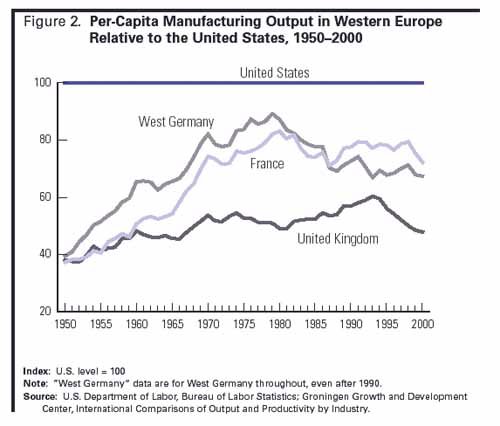
The highest value jobs can be done effectively out of the United States for a variety of reasons. Partially the conventional wisdom in the United States was based on a fantasy world created after World War II when the United States was the dominant economic power. Partially the success of economic (and other) policies of the United States during that period allowed the United States to flourish in the post war period (given the same starting point less effective policies would have lead to less success for the United States and created less of a sense that the natural state was one in which the United States was spectacularly wealthy compared to the rest of the world).

Partially the conventional wisdom was wrong because the wealth that exists in the world today has allowed for huge investments to be made amazingly quickly. That allowed changes to the macro economic environment faster than I can imagine any reasonable person would have expected in 1985. And partially the effectiveness of especially China (but also many other countries in Asia mainly) in improving their economy have been much more successful than could have been reasonably expected. Partially the very high wages paid, might just be too high, we will see. The success of multi-national companies in speeding up the adoption of effective management policies has also been important. Granted I believe the management practiced by most could be greatly improved but still...

I believe we can expect that there will be real competition for high value work from a wide number of countries. That is the reality of the world today. Countries that desire economic wealth are going to find that other countries want high value work also (and are not willing to seed a huge percentage of those jobs to the United States or anyone else). To retain and gain high value work all countries will have to compete with each other. Previous post on science and engineering jobs.

More from, In Global Market, Iowa Manufacturers Fight for Survival:

Two movements that are dramatically changing Iowa manufacturing floors are technology and lean manufacturing disciplines, such as Kaizen, a Japanese approach for continuous improvement.

With nearly 30 percent of the residents in Des Moines, Lee and Henry counties employed in manufacturing, said Hinkle, "it made sense to make southeast Iowa a lean stronghold."


I think we often talk as though manufacturing in the United States is not feasible. Yes, things are changing, and have been for several decades. But the United States is still the largest manufacturer in the world.

I had a great deal of difficulty finding statistics on this (any suggestions for good source of macro-economic statistics on manufacturing would be appreciated). Google and the others still have plenty of room to improve search results. From the WorldBank, I located manufacturing statistics from 2001 (using "value added" - the link to the details on what the figures mean on the page don't work - I would guess the figures are in constant dollars but I can't say for sure).


Country19902001% increase
United States1,040,6001,422,99939
Japan810,231865,8097
China116,572407,513251
Germany456,405385,923 -15
United Kingdom206,718220,4297
France228,270217,534-5
Korea64,604117,57583
Mexico49,992110,381120
India48,80767,14327
World4,412,8375,404,37322


Summers conservatively estimates the company will implement 25,000 employee recommendations throughout its operations this year. The company has 3,800 Iowa employees, called members, with 11,000 worldwide, mostly in the United States.

"Those suggestions are driven by shop floor members who understand where the waste is in their jobs," he said.

Employees are trained in lean techniques and are "encouraged and rewarded to generate and implement improvement ideas."

Mead said about once a quarter, employees work on a lean project within their work area or in other plant operations.


A substantial determinate of where high paid manufacturing (and other) jobs will be is how effectively locations produce. By using lean manufacturing methods (and the like) and taping the brainpower of employees the odds of keeping such jobs in Iowa, and anywhere else is increased. Is it certain to work? No. But the odds of keeping such jobs without using such management improvement strategies is much worse.
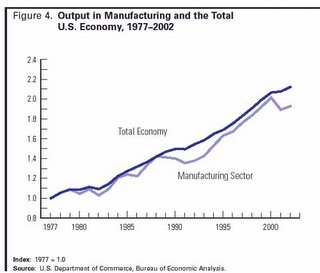
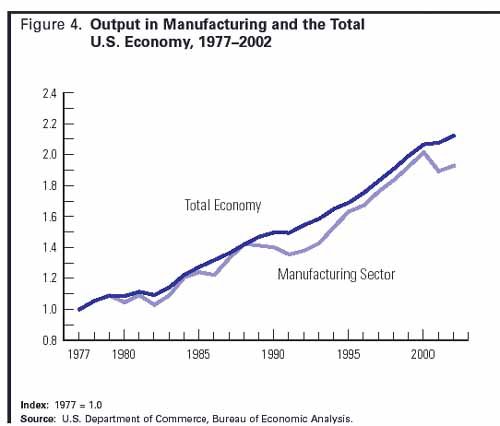
The ratio of manufacturing output to total economic output is not declining much (see chart). Yet, Quality management, lean manufacturing, applied technology, technological innovation, etc. have increased productivity to such an extent that we are increasing production and decreasing employment. I could not find the statistics but my belief is that manufacturing employment has declined substantially globally.

Jobs are leaving the manufacturing sector everywhere. Again, I can't find a source now but my understanding is manufacturing employment in China is down more than manufacturing employment is down in the United States in the last 2 decades. How? Remember that China has radically altered their economy. What existed 20 years ago (and even 10 years ago) was employment at factories largely in name only - employees that had nothing to do. Part of that change is the vastly increased output shown above, another part is the reduction of staff at factories that now are managed to make a profit.

It is true (in my belief - and based on the statistics above and in the graphs) that the United States has been decreasing manufacturing employment. And it is also true other countries - notably: China, Korea and Mexico are increasing manufacturing output. However, I believe the there has been no increase (in fact I believe their has been a decrease) in manufacturing jobs worldwide. The impact of lower wages (in competitive countries), while a factor, is much less important than other factors in the decline of manufacturing jobs in the United States.

The way to create an economy that continues to provide good jobs is to apply the ideas of Deming, lean thinking, customer focus, statistical tools, systems thinking, etc.. We should realize that the United States was in a position from 1950-2000 that was abnormal and is not something that can be expected to return. To achieve economic success in the next 50 years will require doing what we did well last century well again, improving things we could get away with doing poorly and learning and applying new ideas (in management and elsewhere).

As I have stated before, as a county, the United States still has the advantage when looking at the likelihood of economic success in the future. But that advantage is much less than it was in 1950 or even 1970. The conventional wisdom was that the United States could move to "high value" work where we could continue to exist in the way we did in the middle of the last century.

Those who thought moving to high skill jobs was the way to protect economic gains, knew that it was only a temporary state. They implied we could take advantage of that time to become more effective and maintain a significant advantage over others. It turns a handful of countries have reached a very competitive state for even high skill jobs much quicker than most anyone expected.

The future is very bright for the world and for the United States. But the United States is going to have quite a few challengers for providing a location for high skill jobs. It will be very interesting to see what happens in the next 20-50 years.


Is the United States going to be the largest manufacturer in the world 20 years from now? I doubt it, but if you have to pick one country it has at least as much chance as any other (I would imagine today many would give the odds to China, and I would as well). What other country? Japan, I doubt it. Enough of Europe forming into a country, possible but unlikely.

So I would guess China #1 and USA #2 in manufacturing in the year 2025. Hardly a failure to be the second largest manufacturing country in the world. And there is plenty that could go wrong in China and cause it to slip and not catch the United States. But we have experienced amazingly quick macro economic changes recently, so 25 years might leave room for much more change than seems likely today.

Is the United States going to have the largest GDP? I believe so. What countries are likely to do well? That is not an easy question. China and India have done very well the last 10 years. Continuing that success for the next 25 years will not be easy. Again it will be interesting to see what develops.

I believe many factors will define what countries do well: educational system, health care system, existing economic wealth, freedom (economic, personal and political), lack of corruption, the rule of law, management, banking and securities system, innovation system, support for scientific innovation, providing opportunities for all citizens to contribute...

I would guess the USA [GDP growth 1980 to 1990, 1990 to 2003 3.6, 3.3], India [5.7, 5.9], China [10.3, 9.6], Singapore [6.7, 6.3], Thailand [7.6, 3.7], Korea [9.0, 5.5], Costa Rica [3.0, 4.8], United Kingdom [3.2, 2.7], Spain [3.1,2.8] and Mexico [1.1, 3.0] (I may be more hopeful in this pick than rational) will do well (as measured by GDP and increase in total wealth). Others that have a good chance: Malaysia [5.3, 5.9], Australia [3.4, 3.8], Canada [3.2, 3.3], Japan [3.9, 1.2], Vietnam [4.6, 7.5], Chile [4.2, 5.6], Brazil [2.7, 2.6], Egypt [5.4, 4.5], Uganda [2.9, 6.8] and many countries in Europe. Many others also have a chance but success is not going to be easy. The countries listed above will provide formidable competition. However, with proper planning and execution most countries have a chance for great success in the next 25 years, and all do looking 100 years into the future.

Friday, October 28, 2005

Management Training Program

Topic: Management Improvement

Fog Creek Software Management Training Program by Joel Spolsky:

Finally, when you're really really good, they let you hang around with Yussef on the ovens. Yussef was about 100 years old and so good at running the ovens it was scary. When Gabbi tried to show me how to solve the problem of bread sticking to the conveyer belts on the way out of the oven, he ran back and forth like a lunatic for ten minutes, turning knobs, pulling levers, redirecting heat, and burning a few hundred loaves while he struggled to get things under control.

But Yussef, facing the same problem, turned one tiny knob on a seemingly-unrelated chimney about one degree to the right. It made no sense, he couldn't explain why it worked, but it did: it solved the problem instantly and suddenly perfect loaves started popping out. It took me another couple of years to really understand the complex relationships between heat and humidity inside an 80 foot tunnel oven, but it would have taken ten more years before I could solve problems as well as Yussef did.


From the Lion of Lean (an interview with James Womack):
So I said to the Toyota executive, "You've only got two or three suppliers per category, and you never take bids. How do you know you aren't being ripped off?" So this guy, who was around 60, gives me an incredibly frosty look and says, "Because I know everything." Everything? "That's my job," he says.


Reading "Because I know everything" brings to mind an arrogant blowhard to many in America (I think). Probably because most who would say that, are arrogant blowhards. But when someone has worked (a Toyota executive or a baker) for 40+ years in the same area those words can have quite a different meaning than a 31 year old MBA working in this third industry. Managing with constancy of purpose and long term thinking can make a big difference.

Joel Spolsky runs a software company with a different vision than most owners or managers. I don't think he attempts to follow Deming or Lean Thinking or Ackoff. He has very interesting ideas on managing, that he developed himself, as far as I know.

Thus: how do we develop the next generation of managers? We don't really want to hire MBAs, because there's too much evidence that MBAs substitute book-learnin' for common sense or experience. We'd much rather hire someone who created and ran a profitable lemonade stand than someone who has taken two years of finance courses at Harvard, especially since the Harvard MBA is going to think he knows a lot more than he really does.

Our latest thinking is just to train a new generation of leaders from the ground up.

To that end, today we're launching an experimental new program, the Fog Creek Software Management Training Program.

I think this would be a great opportunity for the right person.

A sample of some of his management philosophy.

Hitting the High Notes:
For the last five years I've been testing that theory in the real world. The formula for the company I started with Michael Pryor in September, 2000 can be summarized in four steps:


Best Working Conditions Best Programmers Best Software Profit!
It's a pretty convenient formula, especially since our real goal in starting Fog Creek was to create a software company where we would want to work. I made the claim, in those days, that good working conditions (or, awkwardly, "building the company where the best software developers in the world would want to work") would lead to profits


Bionic Office:
The monthly rent for our offices, when fully occupied, will run about $700 per employee. The build-out was done on budget and paid for almost entirely by the landlord. I suspect that $700 per person is on the high side for software developers throughout the world, but if it means we can hire from the 99.9 percentile instead of the 99 percentile, it'll be worth it.

Wednesday, October 26, 2005

OpenOffice 2.0

Topic: Software - Open Source - Freeware

OpenOffice 2.0, the excellent freeware office suite is now available. It is great free software that imports Microsoft formatted documents and creates the same amazingly well.

Open Office runs on Apple, Linux, Microsoft and more operating systems and installs easily. One nice feature is that you can create pdf documents from any file (text, spreadsheet, presentation) with the click of one button. They also added a new database in release 2.0.

I've used the previous edition for quite some time and think it is very good; it is amazing such a product is free. More excellent freeware: Firefox and Picassa (for photos).

Tuesday, October 25, 2005

Why Fix the Escalator?

Topic: Management Improvement

Why Fix the Escalator? from the Lean manufacturing blog on a visit to the NUMMI plant:

A very large permanent sign above the escalator said something like:

"Sorry for inoperative escalator. It would cost $120k to repair. We feel money could be better spent on other things. Please accept our apologies."

Wow. The frugality and practicality of TPS was illustrated by that sign, our tour group thought. Rather than a knee-jerk reaction of fixing it when broken, somebody asked that powerful question: "Why?"
...
Another question I'm challenging myself with: If this had been a GM plant, would I be criticizing them for being cheap?


Good points and questions. I have another question, why was the escalator put there in the first place? I did not visit the plant but it sounds like it isn't needed. Did something change, or was it a wasteful decision in the first place?

I think we all (including me) have to be careful when we make judgments of those we respect or find wanting. It seems our judgments often have more to do with our opinion of the person or company, than the specific behavior we believe we are judging. At times this is wise, I believe, but you should remember the basis for your opinion.

Right now, I will give Google the benefit of the doubt. If Google does something that I don't understand, I figure they probably understand something that I don't. And it similarly makes sense to think - if Toyota makes a certain decision there is a likelihood it was a good decision.

So if my first judgment was "that it was not the best decision" then maybe I should think more before I commit. I think it is important to understand your thought process in making a decision. So I think it is wise to ask: "If this had been a GM plant, would I be criticizing them for being cheap?"

Going Beyond (or away from) Lean Thinking?

Topic: Management Improvement

Continuous Improvement - Lean Alone No Longer Cutting It by Tonya Vinas, IndustryWeek:

It's a dicey time for manufacturers that have spent the past five to 10 years on the lean journey. They and their top-level executives are finding that lean alone is not enough.


Well I would agree "lean," as it is commonly implemented, is not enough. I believe additionaly ideas from Deming that are missing from many lean efforts would be helpful (Toyota applies Deming's ideas to a much greater extent than those modifying Toyota's practices for their organization). Those concepts will mainly aid long term continual improvement of the organization (rather than provide short term quick fixes).

I think [what is] also happening is a demand for immediate cost cutting that lean doesn't always provide. Sometimes kaizen events result in immediate savings, but in the face of the increases these companies are facing, kaizen-derived savings are, again, probably not deep enough, especially with the allure of incredibly cheap labor in China.


I think moves away from lean, that are the result of gut reactions to such worries, are likely. Also I feel that the rapidly movement of managers and their desire to "make their mark" in their new job, results in new managers making changes (away from lean) mainly to show the impact they have (or because they are not familiar or comfortable with lean concepts). Neither are good reasons for changes, in my opinion.

I think the article raises some interesting questions. I, also, believe the practice of lean is increasing. I would be interested if the readers of our blog think lean thinking is increasing or is on the decline.

Monday, October 24, 2005

Deming's Ideas at Markey's Audio Visual

Last week at the Deming Institute seminar: How to Create Unethical, Ineffective Organizations That Go Out of Business, Mark Miller, General Manager, Markey's Audio Visual spoke on Markey's experience adopting Deming's ideas.

It was a great presentation. He did a great job of explaining what it was like to work at a company focused on applying Deming's management philosophy. I capture some of the points he talked about below.

1986 Markey's started providing Audio Visual support to all Deming's seminars. The technicians came back after 3 sessions to encourage Mark Miller (employee number 16 at Markey's) to attend, himself. He went to a Deming 4 day and decided the owners should attend. They did and then Markey's sent employees to attend future Deming 4 day seminars.

He recommended, The Team Handbook and The Leader's Handbook by Peter Scholtes.

Points:
  • Constancy of Purpose
  • Their business has greatly changed. Customers used to need a service provider to project onto a screen,– now they all own projectors for laptops‚ Markey's needs to anticipate the changing needs of customers and anticipate those needs
  • Page 141 of Out of the Crisis: "Profit in business comes from repeat customers, customers that boast about your product of service" (Markey's uses Deming's books in the training for staff)
  • He facilitates all training sessions (everybody goes through training in groups of 10-12). Half day. They have the afternoon to go observe customer service and write down their experience with 3 customer service interactions.
  • Unknown and unknowable - not really unknown just un-measurable (again taught to all employees)
  • Gemba - where the real work gets done (the customer interaction - he stressed time and again that the key to their success was Markey's employees interaction with customers - Markey's aims to provide the best customer experience the customer has with any company)
  • In 1991 he asked owners do you want to offer jobs or careers - they decided careers started offering 401k... weeks later (statements about valuing employees are not what matters, action based on those statements are what matters)
  • Trust - assume people are good
  • Break down barriers between departments - Markey's doesn't charge internally. Indianapolis looses money - they own the high end equipment used by the other offices.
  • Intrinsic motivation v. Extrinsic motivation - he has the chart from page 122 of New Economics in Deming's handwriting on his wall.
  • 215 employees $30 million in business (about $3 million before Deming)
  • Commission pay - after 10 people attended Deming seminar they stopped using commission pay "people are not motivated by money" people do have salaries they want or need and will change jobs... to get what they need. For commissioned employees pay set at average of last 3 years salary for 7 commission employees - 1 left.
  • No performance reviews - they do have an annual conversation. No ranking or rating. Discuss what you like about your job, who you work with, what do you want to do in 1, 5 years, what frustrates you, how am I holding you back, don't talk about pay. Talk closely with his reports on about daily basis.
  • Promote from within - mainly
  • No layoffs - did once in Toledo when a major customer left (offered jobs in other cities...)
  • They use the "Predictive index"
From Markey's home page: "Dedicated to quality, Markey's strives to continually improve their industry. Directed by the management philosophy of Dr. W. Edwards Deming, Markey's aim is to meet and exceed their customer's expectations."

Thursday, October 20, 2005

2005 Deming Prize

2005 the Deming Prize Winners Announced:

The Deming Application Prize (alphabetical order)

Hosei Brake Industry Co., Limited(Japan) - web site
Krishna Maruti Limited, Seat Division(India)
Rane Engine Valves Limited(India) - web site
Rane TRW Steering Systems Limited, Steering Gear Division(India) - web site

Once again India has dominated the prize. From our 2004 Deming Prize post: "In recent years, Thailand and India have been the home to nearly all awardees: 6 of 7 in 2003, 2 of 2 in 2002 and 3 of 4 in 2001. Prior to this new trend, nearly all awardees were based in Japan,"

Also announced:

The Deming Prize for Individuals
Mr. Hajime Sasaki, Chairman of the Board, NEC Corporation (Japan) - bio

The Japan Quality Medal
Thai Acrylic Fibre Co., Limited (Thailand) - web site (2001 Deming Prize)