Audio CDs of the 2005 W. Edwards Deming Deming Institute Conference presentations ($100).
I attended the conference and posted: "Mike Beck gave an excellent presentation at the Deming Institute conference about the United Technology Corporation management improvement system. I plan on posting more about the session." I have not posted an update :-0 but now you can hear it yourself. I also thought the "Back to the Future" presentation by Larry Smith was excellent. You can also read this article, on the same topic (manufacturing at Ford in the 1970s to today) by him.
The Deming Institute is also presenting a seminar, How to Create Unethical, Ineffective Organizations That Go Out of Business, 24-26 April, 2006 in Boston. I will be co-presenting the seminar. Let me know if you sign up.
The Deming Institute also offers Dr. Deming presenting his Four Day Seminar in 1992 (Eight Video Tape set for $275 - Tape or DVD).
Monday, January 30, 2006

Wednesday, January 25, 2006
Change is not Improvement
Topic: Management Improvement
In response to: Why executives order reorgs
"We trained hard... but it seemed that every time we were beginning to form up into teams we would be reorganized. I was to learn later in life that we tend to meet any new situation by reorganizing; and a wonderful method it can be for creating the illusion of progress while producing confusion; inefficiency, and demoralization."
These lines, from the Satyricon of Petronius written 2,000 years ago...
Unfortunately it seems this quote is not actually his. Instead apparently someone attributed the quote to him to give it the weight of time. I think that the sentiment expressed rings true speaks to the experience of many.
The Improvement Guide: the Practical Approach to Enhancing Organizational Performance, is an excellent handbook on making changes that are improvements rather than just a way to create the illusion of progress. The book uses three simple questions to frame the improvement strategy.
Once the organization does that regularly, the next step is to actually measure the results and validate the success or failure of the improvement efforts.
In response to: Why executives order reorgs
"We trained hard... but it seemed that every time we were beginning to form up into teams we would be reorganized. I was to learn later in life that we tend to meet any new situation by reorganizing; and a wonderful method it can be for creating the illusion of progress while producing confusion; inefficiency, and demoralization."
These lines, from the Satyricon of Petronius written 2,000 years ago...
Unfortunately it seems this quote is not actually his. Instead apparently someone attributed the quote to him to give it the weight of time. I think that the sentiment expressed rings true speaks to the experience of many.

The Improvement Guide: the Practical Approach to Enhancing Organizational Performance, is an excellent handbook on making changes that are improvements rather than just a way to create the illusion of progress. The book uses three simple questions to frame the improvement strategy.
- What are we trying accomplish?
- How will we know that a change is an improvement?
- What changes can we make that will result in improvement?
Once the organization does that regularly, the next step is to actually measure the results and validate the success or failure of the improvement efforts.
Tuesday, January 24, 2006
China now the 5th Largest Economy
Topic: Economics
China's Economy Grew 9.9% in 2005, Overtaking France
2003 data, from Geohive (their source the World Bank):
Related posts:
China's Economy Grew 9.9% in 2005, Overtaking France
China's economy grew 9.9 percent in 2005, overtaking France as the world's fifth largest, powered by exports and investment in factories, roads and power plants.
Gross domestic product rose to 18.2 trillion yuan ($2.3 trillion) after expanding 10.1 percent in 2004, statistics bureau commissioner Li Deshui said today in Beijing. Investment in urban areas jumped 27.2 percent last year, he said.
Gross domestic product rose to 18.2 trillion yuan ($2.3 trillion) after expanding 10.1 percent in 2004, statistics bureau commissioner Li Deshui said today in Beijing. Investment in urban areas jumped 27.2 percent last year, he said.
2003 data, from Geohive (their source the World Bank):
| United States: | $10.9 trillion |
| Japan: | $4.3 trillion |
| Germany: | $2.4 trillion |
| United Kingdom: | $1.8 trillion |
| France: | $1.7 trillion |
| Italy: | $1.5 trillion |
| China: | $1.4 trillion |
| Spain: | $.8 trillion |
| Canada: | $.8 trillion |
| Mexico: | $.6 trillion |
| South Korea: | $.6 trillion |
| India: | $.6 trillion |
Related posts:
Monday, January 23, 2006
Management Excellence
Topic: Management Improvement
My comments on, Take off the Blinders:
I think the question of what other companies have management practices worth studying is interesting. The answer could be very helpful as others could learn from what those companies do. There are at least two difficulties in identifying the: 1) defining what set of criteria would indicate successful organizations 2) most often even companies that are doing many things well leave much to be desired (so picking organizations worth studying can be difficult and even once that is done deciding which practices to credit for the success is often mostly a matter of opinion).
Many organizations do some things very well: Google, Dell, Amazon, Ritz-Carlton, Grameen Bank, MIT, Gates Foundation global health, Ameritrade, SAS, the Container Store, Home Depot, Apple, Snap-on tools, Wikipedia, McDonald's. Southwest Airlines does some things very well (shouldn't they get extra credit for actually being profitable when all around them go bankrupt). Solectron does some things very well, but they have been doing poorly financially for quite some time.
How do we decide what are good organizations? Inventory turns? Profit margin? Growth? Equitable pay for management and workers? Customer satisfaction? An understanding of lean ideas (either with Lean terms or without)? Use of lean tools? Partnering with suppliers? Elimination of waste from processes. Elimination of waste from the entire product cycle? Impact on society? Sales and/or profit per employee? Low employee turnover? Integrity? Providing ever better products and services at ever lower prices?
In some ways looking for organizations using lean ideas (in different situations) and tools seem sensible (how lean ideas are applied in different situations). In others (if you want to find new ideas that might well be adopted by those using lean methods) looking for "excellent" organizations could be helpful.
I think at least two distinct benefits of exploring these ideas. One is finding practices that can be adopted. The second is learning about management practices in organizations and seeing how those practices work within that organizational system.
Most management practices cannot be plugged into any organization and work well. That practice must be applied in a sensible way given the organizational system. Learning how lean ideas (or other good ideas) are applied in varying systems can provide insight into how to integrate ideas for organization that are trying to apply lean practices.
My comments on, Take off the Blinders:
I think the question of what other companies have management practices worth studying is interesting. The answer could be very helpful as others could learn from what those companies do. There are at least two difficulties in identifying the: 1) defining what set of criteria would indicate successful organizations 2) most often even companies that are doing many things well leave much to be desired (so picking organizations worth studying can be difficult and even once that is done deciding which practices to credit for the success is often mostly a matter of opinion).
Many organizations do some things very well: Google, Dell, Amazon, Ritz-Carlton, Grameen Bank, MIT, Gates Foundation global health, Ameritrade, SAS, the Container Store, Home Depot, Apple, Snap-on tools, Wikipedia, McDonald's. Southwest Airlines does some things very well (shouldn't they get extra credit for actually being profitable when all around them go bankrupt). Solectron does some things very well, but they have been doing poorly financially for quite some time.
How do we decide what are good organizations? Inventory turns? Profit margin? Growth? Equitable pay for management and workers? Customer satisfaction? An understanding of lean ideas (either with Lean terms or without)? Use of lean tools? Partnering with suppliers? Elimination of waste from processes. Elimination of waste from the entire product cycle? Impact on society? Sales and/or profit per employee? Low employee turnover? Integrity? Providing ever better products and services at ever lower prices?
In some ways looking for organizations using lean ideas (in different situations) and tools seem sensible (how lean ideas are applied in different situations). In others (if you want to find new ideas that might well be adopted by those using lean methods) looking for "excellent" organizations could be helpful.
I think at least two distinct benefits of exploring these ideas. One is finding practices that can be adopted. The second is learning about management practices in organizations and seeing how those practices work within that organizational system.
Most management practices cannot be plugged into any organization and work well. That practice must be applied in a sensible way given the organizational system. Learning how lean ideas (or other good ideas) are applied in varying systems can provide insight into how to integrate ideas for organization that are trying to apply lean practices.
Sunday, January 22, 2006
Great Charts
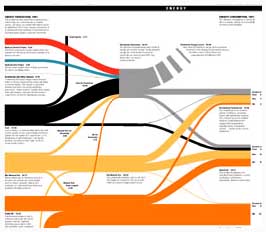 Karl Hartig displays some excellent charts that he created (for the Wall Street Journal) on his web site. The charts seem very similar to what would result from applying Edward Tufte's ideas. Rarely do I see charts that do such a good job of visually displaying data. The lack of such effective visual display of information is another example of how much improvement could be made just by applying ideas that are already published.
The Energy production consumption chart is especially well done I think - pdf version of the energy chart.
Via, The best charts I've ever seen.
Edward Tufte's books are great:
- The Visual Display of Quantitative Information
- Visual Explanations: Images and Quantities, Evidence and Narrative (displaying data over time)
- Envisioning Information
Edward Tufte's web site
Thursday, January 19, 2006
Ackoff Podcast
I found this great podcast via the post - School Architecture: Doing the Wrong Thing Right.
As usually Ackoff provides great ideas, in an interesting and entertaining manner. This talk focuses on learning (and education and teaching) and doing the right things (effectiveness). In talking to educators Ackoff criticizes the educational system. Throughout the speech he does his normal excellent job of explaining system thinking. Enjoy.
Russell Ackoff Talk at Great Schools By Design Summit (mp3 podcast)
As usually Ackoff provides great ideas, in an interesting and entertaining manner. This talk focuses on learning (and education and teaching) and doing the right things (effectiveness). In talking to educators Ackoff criticizes the educational system. Throughout the speech he does his normal excellent job of explaining system thinking. Enjoy.
Russell Ackoff Talk at Great Schools By Design Summit (mp3 podcast)
Tuesday, January 17, 2006
Management Improvement Leaders
Who's Driving Quality Today by Laura Smith, Quality Digest.
Who does Quality Digest select this time? Dennis Arter, Paul Borawski, Joe Bransky, Michael Carmody, Subir Chowdhury, Joe De Feo, Ellen Domb, H. James Harrington, Mikel Harry, Harry Hertz, Robert H. King, Denise Robitaille, Ola Rollen, Shin Taguchi, Jack West and Donald J. Wheeler.
Who would I select, as the leaders of management improvement (lean thinking, six sigma, systems thinking, continual improvement, customer focus, innovation, leadership, quality management, theory of constraints...) thought and practice today? Answering this question leaves me open for criticism (for those I leave off, which might well just be due to the limits of those I am familiar with, and those I include), but I think it is worthwhile. I think those attempting to improvement management will be more successful if they follow the ideas expressed by those I see as having valuable insight.
I don't know where Quality Digest drew the boundaries of "quality" for coming up with their list so I am not claiming the lists are attempting to do the same thing. I will focus on those who are active (though Ackoff and Box are closer to retirement than fully active at this time). Here is my list of those that seem to have risen to the top of the leaders in management improvement (please bear in mind I am basically writing this off the top of my head, I am sure I will miss some important thoughts and my determination of these first seven is not really well thought out):
Many others that have great ideas (some of whom are not very well known): Peter Senge (systems thinking, learning), Peter Block (leadership, community), Roger Hoerl (Six Sigma), Joyce Orsini (Deming, management improvement), Joel Barker (creativity, planning, paradigm shift), Donald Berwick (systems thinking, health care improvement, management improvement, policy deployment), Gerald Suarez (Deming, psychology, systems thinking, management improvement), Clayton Christensen (systems thinking, innovation, strategy), C.K. Prahalad (strategy), Mihaly Csikszentmihalyi (psychology, creativity), Don Wheler (statistics, Deming), Norman Bodek (lean manufacturing), Llyod Provost (Deming, systems thinking, process improvement, statistics, policy deployment), Soren Bisgaard (six sigma, statistics), Steven Covey (time management, prioritization, leadership), Forrest Breyfogle III (Six Sigma), Chris Argyris (psychology, systems thinking, organizational development, learning), David Anderson (theory or constraints, project management, software development), Robert Kaplan (balanced scorecard), Daniel Goleman (psychology, emotional intelligence), William Waddell (lean).
Retired leaders: Peter Scholtes, Brian Joiner, Gerald J. Hahn, Masaaki Imai, Noriaki Kano (I am not sure the last two are retired?).
I would love to hear others comments on this topic in general. I would also be very interesting in:
Related:
Ten years ago, in our March 1995 issue, we profiled 45 "New Quality Gurus." Although it was one of our more popular articles, some of the "gurus" and their causes have faded into obscurity. Other gurus chased the latest fads into oblivion. A few have shown remarkable staying power.
When we decided to revisit the quality gurus issue, one thing was immediately apparent: There isn't any one guru who stands out above the rest. In fact, the quality profession is remarkably free of fads at the moment. Six Sigma has settled into the mainstream, and ISO 9001 has become firmly entrenched in Corporate America. So while we wait for the "Next Big Thing," we're also waiting for the next big guru.
When we decided to revisit the quality gurus issue, one thing was immediately apparent: There isn't any one guru who stands out above the rest. In fact, the quality profession is remarkably free of fads at the moment. Six Sigma has settled into the mainstream, and ISO 9001 has become firmly entrenched in Corporate America. So while we wait for the "Next Big Thing," we're also waiting for the next big guru.
Who does Quality Digest select this time? Dennis Arter, Paul Borawski, Joe Bransky, Michael Carmody, Subir Chowdhury, Joe De Feo, Ellen Domb, H. James Harrington, Mikel Harry, Harry Hertz, Robert H. King, Denise Robitaille, Ola Rollen, Shin Taguchi, Jack West and Donald J. Wheeler.
Who would I select, as the leaders of management improvement (lean thinking, six sigma, systems thinking, continual improvement, customer focus, innovation, leadership, quality management, theory of constraints...) thought and practice today? Answering this question leaves me open for criticism (for those I leave off, which might well just be due to the limits of those I am familiar with, and those I include), but I think it is worthwhile. I think those attempting to improvement management will be more successful if they follow the ideas expressed by those I see as having valuable insight.
I don't know where Quality Digest drew the boundaries of "quality" for coming up with their list so I am not claiming the lists are attempting to do the same thing. I will focus on those who are active (though Ackoff and Box are closer to retirement than fully active at this time). Here is my list of those that seem to have risen to the top of the leaders in management improvement (please bear in mind I am basically writing this off the top of my head, I am sure I will miss some important thoughts and my determination of these first seven is not really well thought out):
- Russell Ackoff - frankly I find it difficult to imagine a list management thought leader list, not including his name. Organizational development, systems thinking, management improvement, planning, policy deployment, learning.
- George Box: statistics, design of experiments, finding solutions (problem solving, process improvement), learning, management improvement
- James Womack and Daniel Jones: lean thinking, lean manufacturing, lean consumption, management improvement
- Eliyahu M. Goldratt: Theory of Constraints (ToC), process improvement, planning, project management
- Gary Hamel: innovation, management improvement, core competency
- Edward de Bono: creativity, problem solving
Many others that have great ideas (some of whom are not very well known): Peter Senge (systems thinking, learning), Peter Block (leadership, community), Roger Hoerl (Six Sigma), Joyce Orsini (Deming, management improvement), Joel Barker (creativity, planning, paradigm shift), Donald Berwick (systems thinking, health care improvement, management improvement, policy deployment), Gerald Suarez (Deming, psychology, systems thinking, management improvement), Clayton Christensen (systems thinking, innovation, strategy), C.K. Prahalad (strategy), Mihaly Csikszentmihalyi (psychology, creativity), Don Wheler (statistics, Deming), Norman Bodek (lean manufacturing), Llyod Provost (Deming, systems thinking, process improvement, statistics, policy deployment), Soren Bisgaard (six sigma, statistics), Steven Covey (time management, prioritization, leadership), Forrest Breyfogle III (Six Sigma), Chris Argyris (psychology, systems thinking, organizational development, learning), David Anderson (theory or constraints, project management, software development), Robert Kaplan (balanced scorecard), Daniel Goleman (psychology, emotional intelligence), William Waddell (lean).
Retired leaders: Peter Scholtes, Brian Joiner, Gerald J. Hahn, Masaaki Imai, Noriaki Kano (I am not sure the last two are retired?).
I would love to hear others comments on this topic in general. I would also be very interesting in:
- Who are the top 5 - 10 leading management improvement experts, in your personal view?
- What are the 5 - 10 books that either, you feel everyone interested in management improvement should read, or you personally find most valuable?
Related:
- Who Influences Your Thinking?
- Curious Cat Management Improvement Blog Directory - many great ideas in these blogs (for whatever reason there are quite a few excellent lean manufacturing blogs - compared to the other areas of focus). Blogs play an increasing large role in influencing behavior (in management and many other areas - management will probably lag compared to many other areas).
Monday, January 16, 2006
Books: Blink, Freakonomics and more
Topic: Economics, Reading, Management Improvement
I finished reading two very popular books this weekend: Freakonomics and Blink: The Power of Thinking Without Thinking by Malcolm Gladwell. While both books were enjoyable and interesting, they really seemed to offer a few good or interesting ideas stretched to fill a book. That is the same thought I had after reading The World is Flat by Thomas L. Friedman. I found all of them fine. I found them to be worth reading, but I don't know they warrant as much attention as they have received.
All of these books are in Amazon's top 30. The only other book I have read, that is ranked so highly, is The Tipping Point: How Little Things Can Make a Big Difference, also by Malcolm Gladwell, which I would recommend more highly.
I also plan on reading Good to Great: Why Some Companies Make the Leap... and Others Don't (25th on the list) which I have been told is very good. I have just started reading: Search: How Google and Its Rivals Rewrote the Rules of Business and Transformed Our Culture ("only" number 377 on Amazon).
The freakonomics blog is execellent. And, as I mentioned in a previous post, Malcolm Gladwell - Synchronicity, the podcast of Malcolm Gladwell is very interesting.
I finished reading two very popular books this weekend: Freakonomics and Blink: The Power of Thinking Without Thinking by Malcolm Gladwell. While both books were enjoyable and interesting, they really seemed to offer a few good or interesting ideas stretched to fill a book. That is the same thought I had after reading The World is Flat by Thomas L. Friedman. I found all of them fine. I found them to be worth reading, but I don't know they warrant as much attention as they have received.
All of these books are in Amazon's top 30. The only other book I have read, that is ranked so highly, is The Tipping Point: How Little Things Can Make a Big Difference, also by Malcolm Gladwell, which I would recommend more highly.
I also plan on reading Good to Great: Why Some Companies Make the Leap... and Others Don't (25th on the list) which I have been told is very good. I have just started reading: Search: How Google and Its Rivals Rewrote the Rules of Business and Transformed Our Culture ("only" number 377 on Amazon).
The freakonomics blog is execellent. And, as I mentioned in a previous post, Malcolm Gladwell - Synchronicity, the podcast of Malcolm Gladwell is very interesting.
Subscribe to:
Posts (Atom)