Friday, March 31, 2006

Lean Aerospace Initiative

Topic: Management Improvement, Lean Manufacturing

The Lean Aerospace Initiative at MIT has a large number of reports, case studies and articles available online.

The Initiative was formally launched as the Lean Aircraft Initiative in 1993 when leaders from the U.S. Air Force, MIT, labor unions, and defense aerospace businesses forged a trail-blazing partnership to transform the industry, reinvigorate the workplace, and reinvest in America using a philosophy called "lean."

The Initiative's stated mission is to research, develop, and promulgate practices, tools, and knowledge that enable and accelerate the envisioned transformation of the greater United States aerospace enterprise through people and processes.

Monday, March 27, 2006

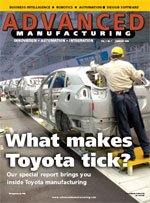
What makes Toyota tick?

Topic: Management Improvement

Advanced Manufacturing magazine continues the focus on Toyota with a cover article, What Makes Toyota Tick? by Vanessa Chris

"Toyota has been coined 'the most feared automaker in the industry.'" Just a few days ago I posted on: Fear Remains a Toyota Motivator. No matter what Toyota continues to be the focus of attention.

Every aspect of the assembly process flows flawlessly into the next - making the plant's 157 processes seem like one. Parts from suppliers are delivered on racks that attach seamlessly onto Toyota's assembly cells. When an assembly line is short on parts, sensors send messages to a team member's wireless PDA, so he or she knows exactly when and what type of part is needed. Every team member here is recertified in six month intervals, to ensure optimal performance. And digital andon boards hanging throughout the facility report issues and the day's progress - as well as any problems - in real time.

In the two-and-a-half years the plant has been in operation, team members have worked diligently to shave nine seconds of takt time off the assembly process without increasing manpower - mainly by focusing on little changes, like putting all fluids in before the final line, and ensuring carpet and seats are installed at the very end to avoid stains or damage.

Lean so lean it doesn't stand out
In this plant, there are no new lean cells that are "under construction." There are no pre-lean horror stories and no wide-eyed employees excited about their newly-organized work area. The lean philosophy is so deeply embedded here it's as if it requires almost no effort at all, emphasizing the differences between first generation lean and, well, a pioneer like Toyota. "It's tough to adapt a whole system to another system that's already in place," says Gerry Malloy, the editor of Canadian Auto Dealer magazine, and a respected automotive industry journalist. "It's how (Toyota's) been doing business from the beginning and it's difficult for other people to catch up."


People might get tired of reading about Toyota but when you read articles like this you see that a principle reason for there being so much focus on Toyota is that they really are doing great things.

The editor's note, Life lessons from a car company? is also worth reading:

These examples, and there are many more, help explain what fuels Toyota's success. There's no question there's something different about this company worth a closer look - and it's not just the top-notch manufacturing technology and advanced lean methods visible on the factory floor. True, some of these factors are "touchy-feely" things that are hard to quantify. But the way Toyota treats its workers, er, team members, also extends to the way it conducts itself with customers, suppliers, the local community, and the environment. It's a holistic approach to running a business that is no doubt hard for many North American-trained business executives to grasp - and even harder to copy.


More reading:
Tags: , ,

Sunday, March 26, 2006

Shenandoah National Park Photos

Topic: ,

photo of vista in Shenandoah National Park

Shenandoah National Park, Virginia, lies in the Blue Ridge Mountains, a few hours from Washington DC. Skyline Drive runs the length of the park as does the Appalachian Trail. I hiked several trails in October, 2004 and took these pictures.

photo of leaves
More of my photos:

Thursday, March 23, 2006

Secrets of the World's Best Companies

Best-kept secrets of the world's best companies by Paul Kaihla.

Not even the most successful companies in the world are managed by the book. Great management formulas aren't handed down on stone tablets, or found in the writings or speeches of gurus and consultants. They emerge from years of experimentation, trial and error, regime change, reorganizations, crises, and employee suggestions.


I agree that management is much more complex than books or simple theories claim. I think one of the great difficulties people have in evaluating management concepts is that the complexity (and interaction) makes it very difficult to evaluate (especially using accurate data).

Still, I think great management ideas are found in the thoughts of leading management thinkers (now it is true most I think most "writings or speeches of gurus and consultants" don't provide much use but the right thinkers do offer great value).

As Dr. W. Edwards Deming said there is no instant pudding for management (no quick fix). And management requires customization to the organization. You cannot just copy management practices from one place, where they are successful, to another. You can learn from what has been successful and adopt it to your organization if you have knowledge and theory and know how to test (pdsa) the effectiveness of new ideas in your organization.

I don't find many of the "secrets" mentioned to be the greatest ideas for management (the best ideas I find among the thoughts of Deming, Ackoff, Ohno, Provost, Csikszentmihalyi, Hoerl, etc..

Still, I believe it is good to learn about what others are doing. Then, as with brainstorming, what you learn about may lead you to a new idea that will work for your organization (you may also get lucky and find something that is almost directly applicable).

If so-called prediction markets--betting pools in which shares are traded to gauge the odds of upcoming events--can call presidential elections and Oscar races with accuracy, why not use them inside companies to identify their next hit products? The answer: It's a lot harder to tap into collective brainpower about a product's market potential, and other key business questions, than it is to foretell the winner for Best Picture.

In his first effort, Proebsting chose 25 programmers and quality-control testers from a team of more than 50 working on a new Windows testing application. Via an internal website, workers could buy shares for the month they believed the product would ship. Shares were valued at $1 apiece, and the engineers drew on accounts stocked with $50 each to fund their bids. Within minutes of the site's launch, shares for a February ship date shot up in value while those for November, the scheduled release date, dropped to almost zero. That came as a shock to the project director, who had heard nothing but optimism in meetings and e-mail updates.


This is one example of an intriguing idea I see here. I think I would see it as a management project that had a very high chance of failing (not providing a reasonable value for the effort expended). Partially this is because working to apply this would put you in largely in unknown territory. This has not been applied for decades by many companies and been refined to a point where experience has shown the strengths and weaknesses in this approach such as: what types of things is this a useful tool to manage.

I've read about similar attempts with decisions on what drug development to fund. Here are some more articles on this topic: The End Of Management? - All seeing all knowing - Trying Out the Wisdom of Crowds

Wednesday, March 22, 2006

Lean and Theory of Constraints

Topic: Management Improvement, Lean Thinking

David Anderson's post, Lean vs. TOC - No Conflict, is an excellent addition to the previous post here: Lean Thinking and Management.

I demonstrated these ideas recently by taking an updated version of my XIT Sustained Engineering paper from the TOCICO in Barcelona to the Lean Design and Development conference and recasting all the exploitation and subordination steps as waste reduction instead.


David refers to a post, looking for a conflict, that is definitely worth reading:

This is the dilemma: "Optimize everything" conflicts with "Only optimize the bottleneck". I like both approaches and have used them both successfully. How is it possible that two of my favourite techniques disagree?


I like the way the post looks at this question. I must admit, my personally view is that the conflict is not as stark as it may appear. I tend to believe the theory of constraints view is helpful but can be misleading since often the interdependencies within the system mean that it is not true that "optimizing non-bottlenecks will introduce waste" (that may be true but is not necessarily true - that is how I see it anyway).

These are good ideas to be discussing.

Related:

Monday, March 20, 2006

Lean Thinking and Management

Topic: Management Improvement

Several interesting posts have been inspired by the Kaizen Priorities post on Got Boondoggle. While it has been mentioned debating these ideas may not be valuable, I believe it can be valuable to explore the reasons behind the different views.

Bill Waddel's post, Lean Manufacturing, points to the importance of cycle time reduction (versus the priorities mentioned in the original post). I think that point is valuable. He also talks about the reasons for Six Sigma's failures and the difficulty finding lean manufacturing success stories (outside Toyota).

I agree that we should acknowledge the paucity of success stories. The failures of management are not minor. The problems are large and the successes seem limited. The biggest thing I think we need to learn from this is that improving management is not easy. The concepts may seem simple but most of us can look around and see much more Dilbert Boss behavior than lean thinking behavior. And the gap between those two types of behavior seems to rise as you go "up" the organization chart.

My belief is that an organization must slowly and consistently move in the right direction. Toyota got to where it is today after many decades of continuous improvement. I don't think there are shortcuts to truly operating as a lean company.

However that does not mean that an organization cannot move in the right direction. I think many alternatives can help start that journey. To me the most important factors to whether the steps will actually lead anywhere are:
  • success that builds upon success upon success...
  • a commitment to continuous improvement
  • a commitment to learning
  • long term leadership for management improvement
To me most organizations will not even seriously consider changing the current management thought process without drastic threat (bankruptcy) or numerous successful improvements that give credibility to the new management ideas. Therefore to me the most important thing is finding a way to successfully introduce ideas and build upon those successes over time.

The second through fourth factors might not even be present at first. I believe it is perfectly fine to start with successfully improving and only after people start to take notice work on those points. And don't expect that to be easy. I believe most organizations never will accept that anything other than a few new tools are needed. And they move on to the next fad (Management by Objective, TQM, Re-engineering, Six Sigma, Lean Thinking...).

To me "Kaizen Priorities" was about what to actually do now. "Lean Manufacturing" is about what to do now (reduce cycle time) and warning about the fact that most likely the overriding management will not change. In The Heart of the Matter, Bill Waddel quotes Bryan Lund:

A select number of companies will "get it" by researching the history of TPS and understanding why TPS is what it is today, by educating themselves and through deep experiential reflection. Those companies will be the most successful in the world. The bulk of the companies in the world will continue to apply the tools, always scratching the surface, never knowing what is at the heart of TPS.

Right on. Bill goes on to talk about the importance of (in my words) transforming the way management thinks versus just applying some new tools without changing the current management beliefs. I completely agree that the largest benefits will go only to those organizations that change the way management thinks. I also believe that is a very difficult task.

I agree we need to find ways to improve the success of management improvement going forward. I agree we would be much better off if we could come up with ways to speed up the adoption of better management. But I really think we need to focus on how to be successful and then worry about speeding it up.

In Kaizen Priorities Part 2, Mike Wroblewski states:

This point leads to the concept of kaizen. I was taught kaizen is more than just continuous improvement of a process or cycle time focused, it is about people. The meaning of kaizen includes the development, training and improvement of people along with removing the burdens that people deal with in work.


As this is done I think we build the capacity of the organization to accept and move forward more lean thinking. Getting the management system to adopt the ideas is much more challenging (than starting to apply some tools) but I think progress is being made.

Still I am confident in the next 10 years there will be much, much more success at applying lean tools more widely than there will be in creating organizations that management is truly knowledgeable and effective in using lean thinking.

I would love it if I am wrong and many organizations adapt a lean management system but I think we have a very difficult task ahead of us. Hopefully the success of those applying lean tools will spur the interest of some using those tools to see what more there is to this lean stuff. And hopefully some of them will join our effort.

Hopefully this discussion can continue (for quite a long time) because I think we are only scratching the surface of what is possible.

Friday, March 17, 2006

Deming and Toyota

Topic: Management Improvement

In response to Deming Electronic Network message, Deming and Toyota:
"I have read a few of the threads referring to Toyota and their success. I am somewhat familiar with the Toyota Production System (where Lean principles sprouted from), but I have often wondered if Toyota subscribed to all of Deming's 14 points.

I believe Toyota applied Deming's ideas to create a management system and continued to develop that system to create the Toyota Production System (also known as lean manufacturing). I believe a convincing argument can be made for Toyota following all 14 points.

An interesting article on Toyota's web site illustrates their commitment to several of the points, Toyota Special Report: Thinking Production System.

Another interesting document, on Toyota's web site is an environmental and social report - that while it does not mention Deming's 14 points does illustrate their belief in several of them (for example: "We must provide to customers cleaner, safer, and more attractive products with excellent value. To shareholders, we must enhance share value through long-term and stable growth by increasing profits and paying appropriate dividends. With business partners, we must engage in fair business based on a spirit of mutual benefit.").

I do not believe Toyota has "abolished the annual rating or merit system" - I may be wrong (I just figure I would have heard of it if they had).

One point that I believe people confuse is, "eliminate numerical goals, numerical quotas and management by objectives." Toyota does mention numerical goals. However, the way they talk about numerical goals I do not feel conflict with Deming's point. For example, see: Innovation at Toyota.

I believe they subscribe to: "Drive out fear and build trust." But that doesn't prevent conflict at times that certainly must bring up fear in some. But taking this seriously and attempting to work on doing this I think is part of Toyota's management system.

John Hunter

Using Design of Experiments

How to Institute DOE in Your Company by Davis Balestracci:

DOE works, but I don't need to sell that to the readers of this newsletter. But as certain as we all are, no one can deny that design of experiments faces resistance even in environments where it is a proven tool. Every research scientist or engineer who has had a major success from DOE can tell you story after story of how management still wanted problems solved one-factor-at-a-time.


Design of Experiments (DoE) was developed by R.A. Fisher in the 1920s (related terms: factorial design, multivariate expertness). Six Sigma was the first general management approach that specifically highlighted the use of Designed Experiments for improvement. Still the use of factorial designed experiments is much less than it could be.

A Brief Overview of DOE from the Macomb Intermediate School District which has a high school course on the topic.

Design of Experiments can seem complicated but at the core it is fairly simple and powerful. By applying the proper techniques it allows you to gage the effect of several variables and, very importantly, the interactions of those variables with a small number of experiments (or tests or pilots).

George Box is a wonderful author (and friend) who can write for mangers who are not knowledgeable about statistics and statisticians. Statistics for Discovery does a good job of explaining how organizations should use experiments to improve.

While the adoption of DoE is still growing slowly, an increasing number of organizations are using DoE to improve. In the past most companies (in most industries anyway) did not have to compete with others that were using DoE to improve. But as more adopt DoE as one more tool to help increase the pace of improvement those that fail to take advantage of this tool will find themselves at a serious disadvantage.

Related links: